In the Talmud, Rabbi Eliezer teaches his students, “Repent one day before your death.” His students were confused. How could anyone possibly know when they were going to die? Rabbi Eliezer responded, “All the more so, let a person repent today, lest they die tomorrow.”
Rabbi Eliezer was not intending to frighten his students. Rather, he was teaching them about the danger of postponing the things that matter most. We tell ourselves that tomorrow we’ll apologize, next week we’ll reconnect with an old friend, or next month we’ll finally begin making the changes we’ve been thinking about. But Rabbi Eliezer reminds us that tomorrow is never guaranteed.
We witness this same human tendency to delay taking action in this week’s Torah portion, Parshat Noach.
God sees that humanity has become wicked and corrupt and decides to destroy the world through a great flood. However, God chooses to save Noah and his family, instructing Noah to build an ark that will protect them from the coming destruction.
The rabbinic commentator Rashi offers an interesting explanation for why God specifically instructed Noah to build an ark. Rashi teaches that God wanted people to notice this enormous structure being built and approach Noah to ask what he was doing. This would give Noah an opportunity to warn them of the coming flood and encourage them to change their ways before it was too late.
According to rabbinic tradition, Noah spent 120 years building the ark. Imagine that! 120 years for humanity to recognize its wrongdoing, change its ways, and possibly even prevent the destruction that was coming.
And yet, despite all that time, humanity did not change. And even Noah himself hesitated to act.
In our Torah portion, we read, “Noah was 600 years old when the Flood came, waters upon the earth. Noah, with his sons, his wife, and his sons’ wives, went into the ark because of the waters of the Flood.” (Genesis 7:6–7).
Notice those final words: because of the waters of the Flood.
Rashi, drawing on the Midrash, teaches that Noah himself was hesitant to believe the flood would actually come. In fact, he waited until the floodwaters forced him to enter the ark. After 120 years of building and preparing, Noah still waited until the moment the water reached his ankles to seek safety.
And isn’t this something we can all relate to? How often do we know what needs to be done, recognize the urgency of a situation, and yet still find reasons to wait? Perhaps Noah doubted that God would actually destroy the world. Perhaps he doubted that humanity could actually change. Whatever the reason, his hesitation reminds us how easily we can convince ourselves that there will always be more time.
And I think this lesson is especially relevant when we look at the world around us today. It seems that every day we are confronted with another unprecedented challenge. We hear warnings about the effects of climate change, the dangers of rapidly advancing technology, and the wars and violence that continue to devastate communities around the world.
And when faced with challenges of this magnitude, it can be easy to feel overwhelmed. To retreat, to look the other way, or to convince ourselves that we are only one person, so what difference could we possibly make? But perhaps that is exactly what Parshat Noach is challenging us to reconsider. We cannot wait until the floodwaters are up to our ankles before deciding to act. We cannot wait for someone else to make the changes we hope to see in our world nor wait for the perfect moment to begin doing what we know is right.
Each day we are given the gift of life, and with that gift comes the opportunity to do something meaningful. To reach out to someone who needs us. To stand up for what we believe in. To bring a little more kindness, compassion, and goodness into our world.
And so, on this Shabbat, may we be inspired by the words of Rabbi Tarfon, who teaches, “It is not your duty to finish the work, but neither are you at liberty to neglect it.” (Pirkei Avot 2:16).
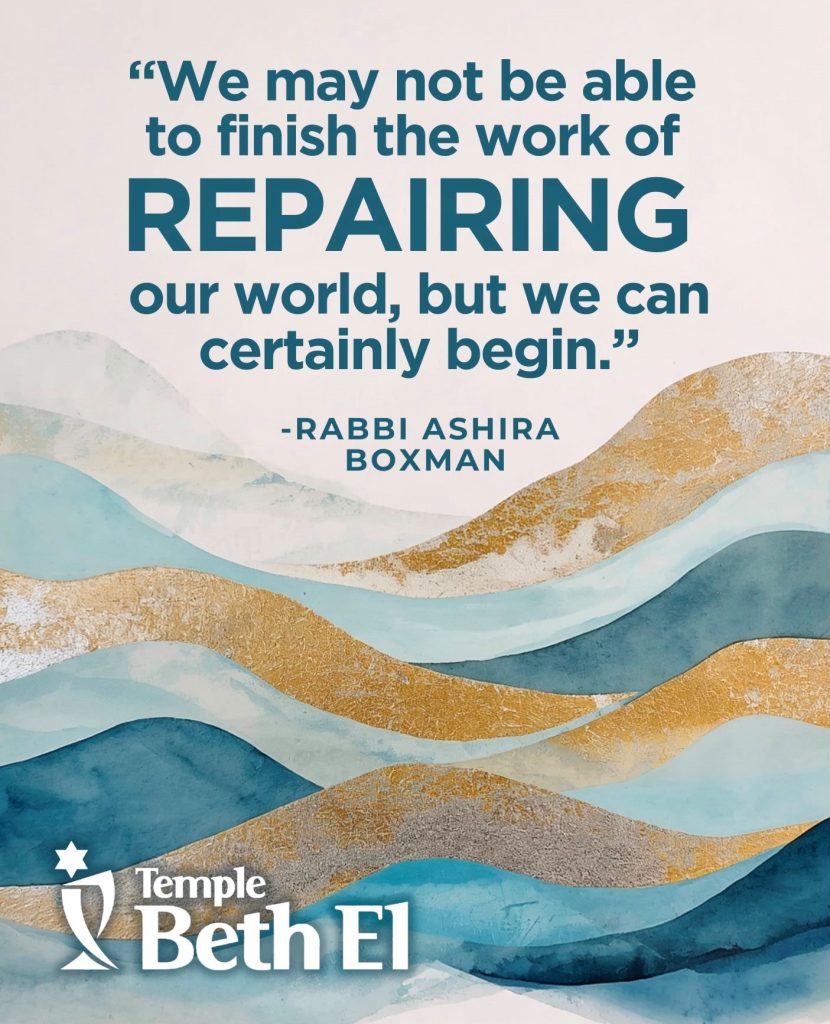
We may not be able to finish the work of repairing our world, but we can certainly begin.
Shabbat Shalom,
Rabbi Ashira Boxman