Click here to listen to an audio recording of this Shabbat Message by Rabbi Dan Levin
Recently, a friend was visiting his daughter and son-in-law. He was playing with his grandson, and he saw the little boy about to do something dangerous. He called out to his grandson, “Hey! Stop! Come back!” The little boy looked back at him startled, with a look of surprise.
My friend’s daughter spoke with him and said, “Dad, we don’t raise our voice with our son. We don’t ever want him to be afraid of us.”
My friend replied to his daughter, “I understand, and I’m sorry if I startled him. But I think it’s a good thing for your son to be a little afraid sometimes.”
There is a complicated relationship between fear and love.
We think fear means we are unsafe, whereas love makes us feel secure and accepted. Fear seems to suggest distance; when we’re afraid, we want to run away. But love seems to imply intimacy, a desire to get closer.
But the Torah teaches that love and fear are actually complimentary partners in fostering a relationship with God, and each other.
In Parashat Ekev, Moses describes all the blessings that will follow from keeping God’s commandments, and also the punishments that may ensue if we forsake God’s covenant and violate God’s laws.
And then Moses asks a powerful question:
“And now, O Israel, what does YHVH your God demand of you? Only this: to fear YHVH your God, to walk only in divine paths, to love and to serve YHVH your God with all your heart and soul…”
Not all fears are the same. There is the fear you feel when you’re in imminent danger, when you’re afraid of something bad that will happen to you. In Hebrew, that word is פחד – Pachad – which means “terror.”
But there is a different kind of fear, which in Hebrew is יראה – Yirah – which is the reverence that comes from wonder and amazement.
Terror – Pachad – can sometimes be quite useful. Recently we spent a few weeks in the mountains of North Carolina. Some of the roads are very narrow, with lots of sharp curves near steep cliffs. Aimee hates these roads. She’s terrified we will go over the edge, or that we may hit a car coming around the bend.
That kind of fear can be helpful – I always do my best to drive very carefully on those winding roads, in order to keep each other safe, as well as our marriage.
But Pachad can also be destructive and debilitating. If we allowed that fear to keep us from never driving on winding roads, we would miss visiting beautiful places, or traveling to see good friends and people we love.
Moses does not want the people to live in Pachad – terrified of God and what God might do to them. Instead, Moses wants us to live with Yirah – with awe and reverence for all that God is. And so Moses asks us to revere … and to love.
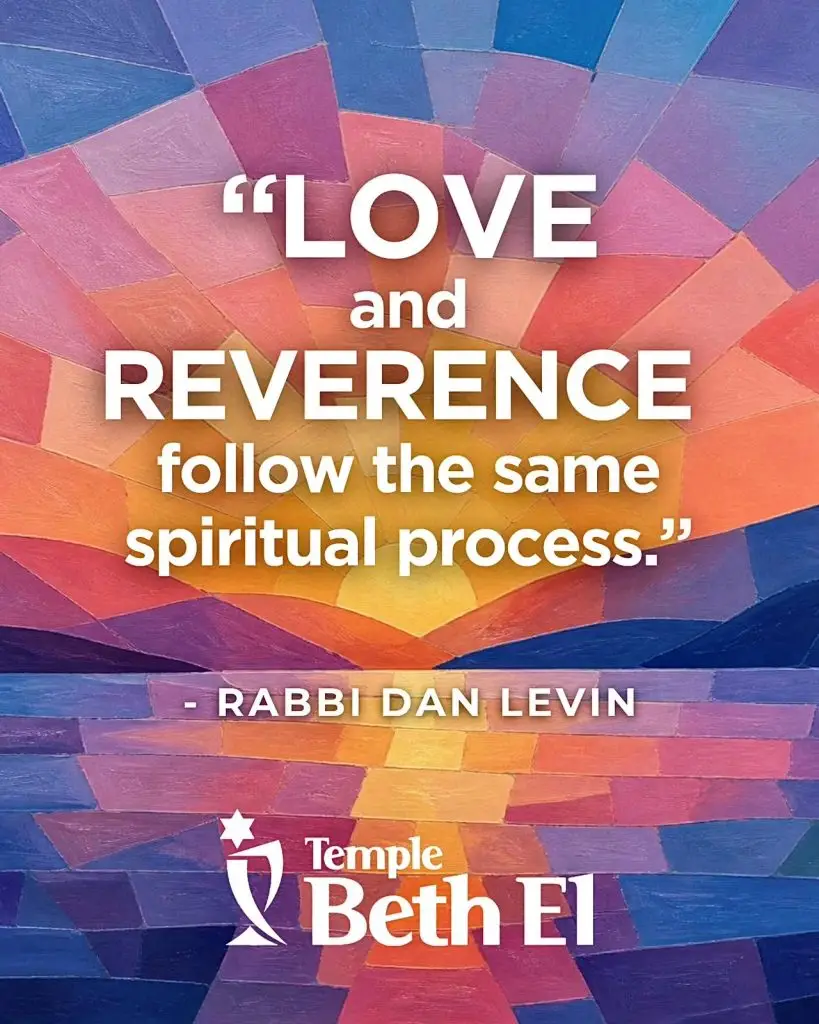
Love and Reverence follow the same spiritual process. Reverence is inspired by deep understanding and appreciation. Think about what makes you stand back in awe. It’s when you finally grasp just how extraordinary something is, when you become aware of the enormity and grandeur of something wondrous and amazing.
And love is the same. I can’t really love someone until I am able to stand back in awe and reverence for who that person really is – for all that they truly are.
As that little boy grows to understand his grandfather, he will become more aware and appreciative of how much experience and wisdom his grandfather has to share. He will learn how much his grandfather loves him, and how deep is his desire to protect him and guide him to have the best life he can.
And just as that little boy’s growing awareness will inspire him to love and revere his grandfather, so too will our growing reverence for the wondrous, holy gift of life inspire us to love the Creator of our glorious universe.
As we cultivate our appreciation for all the gifts of Creation, we may find our growing awareness inspires a bit of fear, a bit of love, an appreciation for the wisdom of Torah and tradition, and an ever-growing desire to partner with God to fill our lives and our world with good.
Shabbat Shalom,
Rabbi Dan Levin
Temple Beth El of Boca Raton