
Can we do right in the face of being wronged?
This week we read the curious story of Jacob, his two wives Leah and Rachel, and their opportunistic father, Laban.
Jacob had come to live with his uncle Laban and was immediately taken by Rachel’s beauty. Poor and alone, he could offer only his labor in exchange for her hand, and he agreed to work seven years. Because he loved her so deeply, the Torah says, those years seemed to him like just a few days.
In the biblical world, marriage was, among other things, transactional. Fathers looked for husbands who could offer something in return, like years of free labor. Men looked for families of means, seeking a dowry that would ensure they could provide. There were roles and responsibilities, a script to follow, and clear expectations.
Jacob, earlier in his life, was known for bucking tradition and taking advantage of others’ vulnerability. He grappled with his brother Esau even before birth. Rebekah was told in a vision that the younger twin would take dominion over the elder, and she felt the two struggling in her womb. Jacob was then born holding on to Esau’s heel, striving to be the dominant brother. As young men, Jacob outwitted Esau while Esau suffered lapses of judgment. Fearing Esau’s revenge, Jacob fled to Laban’s land, where he found the love of his life.
Jacob arrived in Haran carrying the moral lapses of his youth, but he quickly learned how painful it is to be taken advantage of. To his dismay, Laban pulled the wool over his eyes, concealing the bride’s identity on the wedding night. Instead of Rachel, Jacob married her older sister Leah, for whom Laban had struggled to find a husband. Laban then offered Jacob Rachel as well, at the price of seven more years of labor. Jacob agreed, and the three of them, along with the handmaidens Bilhah and Zilpah, raised a family that would grow to twelve sons and a daughter. After the birth of Joseph, the eleventh son, Jacob asked Laban for permission to return to his homeland with his family.
After decades of service, during which he had greatly increased Laban’s holdings, Jacob finally saw his chance to go out on his own and build a flock that could sustain his family. As they made their final arrangements, Laban asked, “What shall I pay you?”
“Pay me nothing,” Jacob said. Instead, he asked to pass through the flock and remove every speckled and spotted animal. “Such shall be my wages.”
Laban agreed, noting that God had blessed him through all that Jacob had done. Jacob was open about which animals he was taking, treating Laban with the integrity Laban had failed to show him time and again.
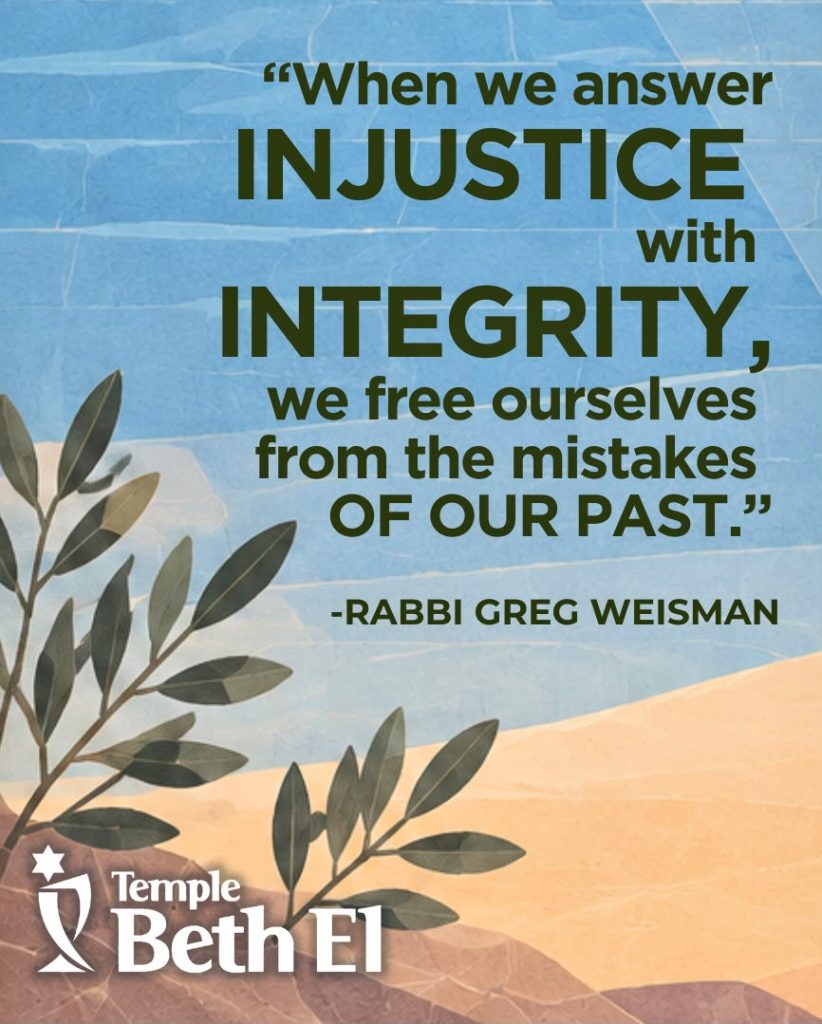
Being wronged does not oblige us to become wrongdoers. The harm done to us may shape our story, but it does not have to write our character. When we answer injustice with integrity, we free ourselves from the mistakes of our past, and free us to becoming who we want to be.
That was the journey Jacob went on. We know he was capable of cunning and trickery; he used it against Esau and his own father, Isaac. When Laban first took advantage of him, we might have expected Jacob to exact revenge in an underhanded way. Instead, he lived out an aphorism of our own era: living well is the best revenge. He spent those years with Laban in honesty and integrity, building a family and serving Laban’s land and flock with diligence and loyalty.
In the end, Jacob was rewarded with a strong flock, a large family, and ultimately the honor of becoming the namesake of our people. As we navigate the challenges in our own lives, let us take this story of Jacob to inspire us to learn and grow from our pasts, so we can do right in the future that is in front of us.
Shabbat Shalom,

Rabbi Greg Weisman