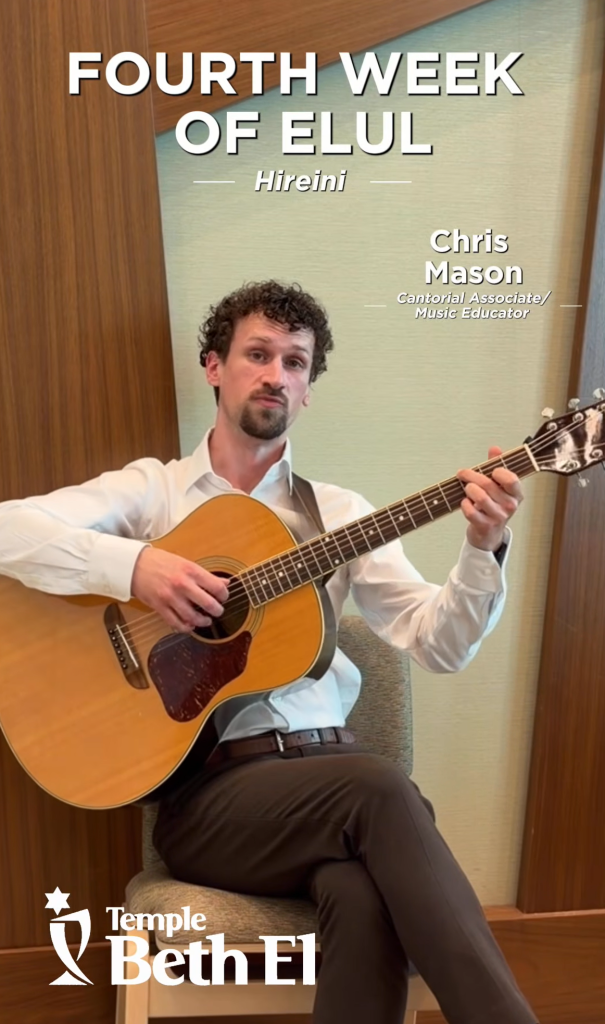
Click Here to view a video of Hineni performed by Cantorial Associate Chris Mason
In the late 1970s, every kid wanted an Atari 2600, one of the earliest and most popular video game consoles. Kids would spend hours breaking their wrists on simple joysticks, trying to save the world from invading “Space Invaders.”
Like every kid, I begged for an “Atari.” But my dad had something better in mind. He took me to the electronics store and instead, bought an Atari 800 home computer.
The Atari 800 was one of the very first home computers. Ours had 8k of memory (yes, you read that right). In addition to a few different games, it also featured one of the simple early programming languages called BASIC.
You would turn the computer on and after a few moments of loading, a very simple prompt would appear: “READY.”
I’ve always thought about that prompt – “READY.” It was more than an invitation to tell the computer what to do. It was an announcement of the computer’s state of being – prepared and all set to be given the next task.
The Hebrew equivalent of that prompt is הִנֵּֽנִי – Hineni which translates as “Here I am.” At different times, this is how our ancestors respond to the presence of God. God calls out to Abraham, and he answers “Hineni.” God calls to Moses from the burning bush and he too answers “Hineni.”
Theirs was the same posture as my old computer – ready to perform God’s will.
Moses in this week’s Torah portion also asks his people to assume this same posture. Standing there in the plain of Moab, overlooking the land where they will finally be at home, Moses invites the people to join a covenant with the Holy One: “in order to establish you this day as God’s people, and thus to be for you your God.” (Deuteronomy 29:12). He asks if they are ready, if they are willing to set aside their own wants and desires and to live in accordance with God’s laws and commandments.
Most of the time in life, we think of ourselves as programmers for our own life. We sit down at the keyboard and decide what we will program ourselves to do. We choose what tasks we will perform based on our passions and desires, what looks most appealing and what feels good.
But tradition invites us to open ourselves up to a new possibility. What if we invited God to sit down at our keyboards? Would we offer God that prompt: READY?
The fact is change is hard. We get used to the way we live, and comfortable with the way we are. Our habits may be bad, and our lifestyles may be unhealthy, but still, we resist the call to change. We tell ourselves: “Well, that’s the way it is.” Or, “I’m too old to change.” Or, “It’s different today.”
We close ourselves off to the possibility that there could be a different path we could take, a different way to relate to those we love, a different way to live.
In the Pirke Avot, Rabban Gamaliel said: “Make your will God’s will, so that God will make God’s will, your will” (Pirke Avot 2:4). His guidance is challenging and perplexing.
Over the centuries, we have discovered holy code, the sacred wisdom of Torah and tradition. Imagine, as we approach the New Year, we could let down our guard, release our tight grasp on old habits and say to the Author of the Universe, “Program me. Upload into my soul holier insights. Show me better ways of being. Teach me what to do, so that I can improve the quality of my life and my relationships with those I love.”
Perhaps renewing our ancient covenant might teach us to see that God’s presence can be found in everything, everywhere, in every moment. Perhaps new programming might open us to a more profound awareness of who we ought to be, and how we ought to live.
As we approach the New Year, let us learn to be open and willing to live differently. Let us be open to greater wisdom, and learn to say, “Hineni – Here I am. READY.”
Shabbat Shalom,

Rabbi Dan Levin
Temple Beth El of Boca Raton