Click here to listen to an audio recording of this Shabbat Message by Rabbi Dan Levin
This past week, America observed what I consider to be a day of significant religious importance: National Chocolate Chip Cookie Day.
I was unaware until thhttps://youtu.be/AsVD-Xzha3Qis week that such a day exists, and being religious as I am, I felt compelled to observe this day with full intention.
Part of my family lore is that my great-grandfather, Henry Harris, invented the ice cream sandwich. While some believe that an anonymous pushcart peddler who served ice cream between two wafers was the original inventor, my great-grandfather had a better idea to sell ice cream between two cookies. But, he never applied for a patent, and so ….
So, on Tuesday, I found a small bakery selling two absolutely delicious chocolate chip cookies with chocolate ice cream inside. It may have been the most delectable dessert I have ever eaten.
This week, in Parashat Re’eh, Moses reiterates for the Israelites the animals they are permitted to use for food. Animals must have cleft hooves and chew the cud – so a cow, or goat, or gazelle is permitted while lions, tigers, and bears, and of course pigs, are forbidden. Fish must have both fins and scales – so salmon and tuna are acceptable, while crab and lobster are not. We may not consume birds of prey, so the Torah lists a variety of birds to avoid, like eagle or falcon or hoopoe.
Growing up, I not only ate chocolate chip cookies, but all kinds of things the Torah forbids. My parents believed deeply in practicing Judaism, but the laws of kashrut were not compelling. So, we enjoyed annual trips to the Delaware shore for crabs, and made pepperoni pizza in our kitchen.
But in college, I studied the laws of kashrut and decided to be more deliberate in keeping kosher.
Being human means that we belong to the world of Creation, and like all creatures, we have to satisfy our physical needs. We walk and roam. We eat and we sleep. And this week’s Torah portion teaches that we may slaughter another living creature and eat meat to satiate our hunger.
But being human also affords us the opportunity to experience the realm of the spirit. And that means we cannot be driven solely by impulse and desire.
To inhabit the world of the Divine, we learn to master our instincts in order to impose moral choice over primal urge.
Kashrut is a grand laboratory to practice the exercise of moral judgment. The fact is stuff tastes good. And when stuff tastes good it gives us pleasure. And shouldn’t we indulge in what gives us pleasure?
But just because something feels good doesn’t mean it is good.
If someone makes me angry, it might feel good to rear back and sock them in the kisser, but I have to restrain that urge … because it’s wrong.
We work hard for what we earn, and naturally we want to hold on to our money, but we push ourselves to give Tzedakah and help those less fortunate … because it’s right.
Keeping kosher requires us to master our yearnings in order to make a moral statement.
We abstain from eating predators or bottom-dwellers or scavengers. Instead, we restrict ourselves to creatures who are pastoral and docile – after all, you are what you eat.
We recognize that for us to satiate our hunger with meat, another creature has to perish. So, we refuse to mix milk and meat together – for one is a symbol of its life, and the other a symbol of its death.
I will admit – despite my desire to shed a few pounds, it’s hard to curb my craving for chocolate chip cookies. And it’s also hard to curb all the impulses that lead me to do the wrong thing.
But the key to morality is exercising forbearance and restraint, acting with thoughtful and deliberate intent in every moment.
It’s hard to live deliberately. It requires discipline and focus, the cultivation of awareness and sensitivity.
But these are the tools for moral and ethical living. These are the keys that unlock the doors to the realm of the holy.
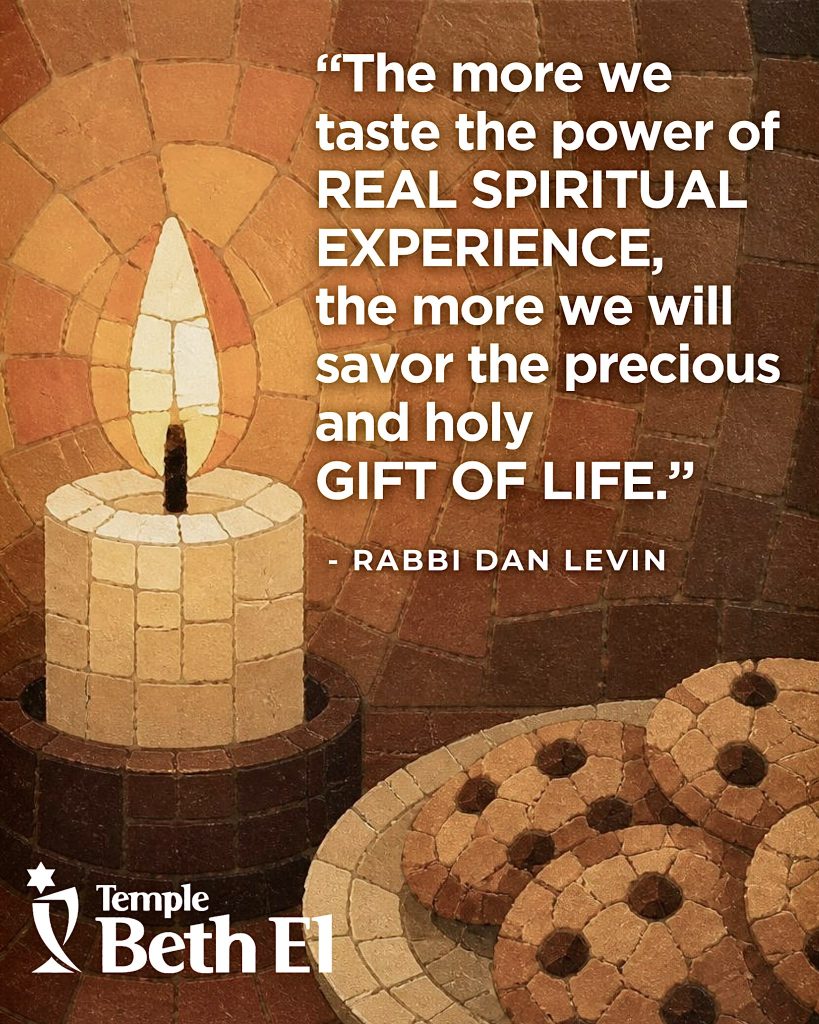
And the more we taste the power of real spiritual experience, the more we will savor the precious and holy gift of life.
Shabbat Shalom,
Rabbi Dan Levin
Temple Beth El of Boca Raton