Growing up at a Reform summer camp, I remember there always being one specific day when my one more traditional friend would go to another building during meal times. She was joined by maybe five other campers who also came from more traditional families, while the rest of the 500+ campers would eat their normal breakfast, lunch, and dinner in the chadar ochel, the dining hall. To be honest, as a young child, I never truly understood why she would do this. I just knew it was for a certain Jewish holiday when you fasted, and that my family never really observed it.
That holiday was Tisha B’Av.
This past Wednesday night, we gathered here at our temple to observe this very holiday. Tisha B’Av, the ninth day of the Hebrew month of Av, is traditionally considered the saddest day on the Jewish calendar. It is a day of fasting and mourning, when we read from the Book of Lamentations and remember the destruction of both Holy Temples in Jerusalem. Over time, other tragedies throughout Jewish history have also become associated with this day, making Tisha B’Av a time when we collectively mourn the pain, destruction, and loss our people have endured throughout generations.
Years later, as I learned more about this holiday, I began to question why it was not observed more broadly in Reform Jewish settings. Through that learning, I came to understand that while other tragedies throughout Jewish history may have coincided with the ninth of Av, it is the destruction of the Temples that really dominates the day’s rituals and liturgy. And the destruction of the Temple is not something that Reform Judaism has traditionally viewed with the same sense of sorrow. Reform theology does not generally look upon the end of Temple worship, or the dispersion of the Jewish people from the land of Israel, solely as catastrophes to be mourned. After all, we do not pray for a return to the Temple or to the system of sacrifices that once took place there.
However, in learning more about this holiday, I uncovered something deeper than just a yearning to return to Temple times or a mourning for the Holy Temple, something that, personally, I had a difficult time connecting to. I began to see Tisha B’Av as a day that represents the brokenness of the Jewish soul and a tearing of our collective peoplehood. It reminds us of just how fragile our culture, our religion, our peoplehood, and our land can be. It reminds us how quickly it can all be threatened, and how important it is for us to treasure it, nurture it, and hold onto it tightly.
It reminds us of how we felt on October 7th.
Remember that aching feeling in your stomach? That tear in your heart? The tears that filled your eyes on October 7th? Those physical emotions and reactions, that was peoplehood. Though we might have been thousands of miles away, we felt that pain in our bones. And perhaps that gives us a glimpse into how our ancestors felt when the Temples were destroyed. We know something of that feeling of emptiness, fear, and uncertainty. We know what it feels like when something that happens thousands of miles away can feel as though it is happening to us, because it is happening to our people.
And at the same time, we also know well what can come after tragedies like these: Jewish resilience. Brothers and sisters coming together. Raising money for those most affected. Visiting victims. Sending supplies and whatever else is needed. Advocating to bring home our hostages. And becoming ever more committed to our people, our land, our culture, and our religion.
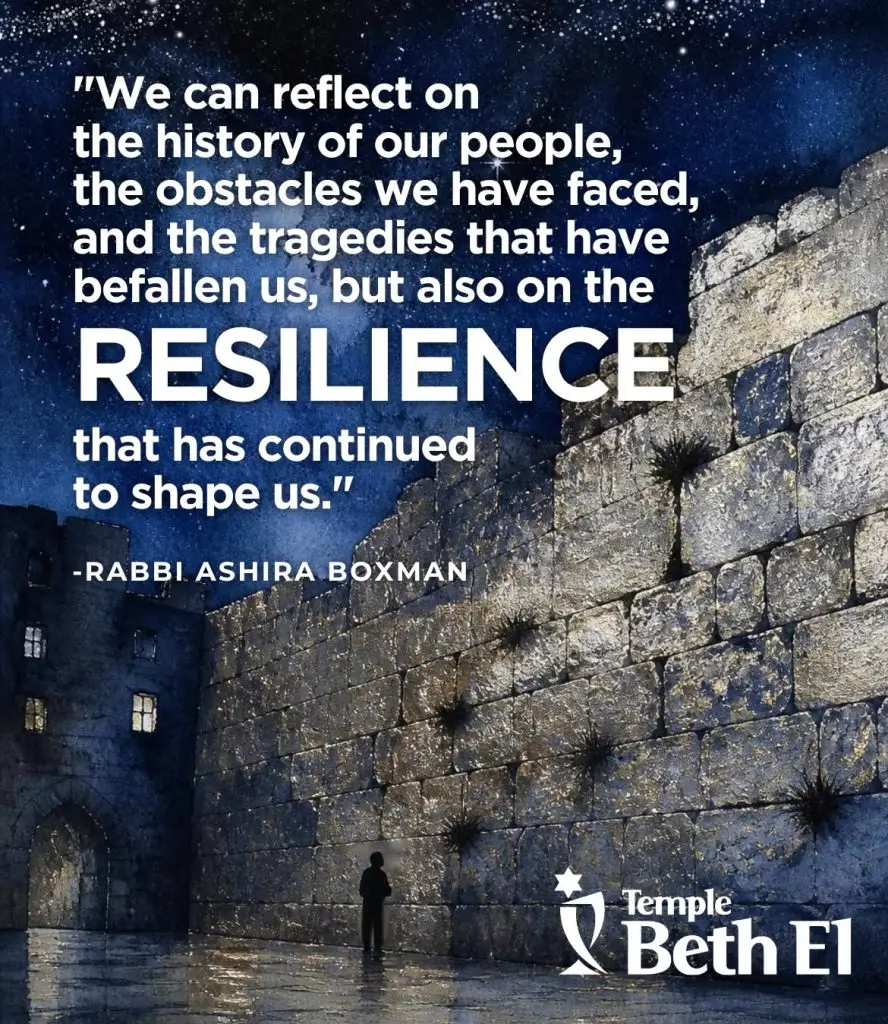
And so, even though Tisha B’Av has now passed, perhaps its message is one that we can carry with us beyond the ninth of Av. We can reflect on the history of our people, the obstacles we have faced, and the tragedies that have befallen us, but also on the resilience that has continued to shape us. Because perhaps Tisha B’Av is not only about remembering what we have lost. It is also about recognizing what we still have, understanding just how precious and fragile it can be, and recommitting ourselves to protecting it, nurturing it, and carrying it forward for generations to come.
Shabbat Shalom,
Rabbi Ashira Boxman