In May of 2005, I received a phone call that changed the course of my life. I was on my way to my final class of college when an unknown number from an unknown area code rang. When I answered, a man with the thickest southern accent I had ever heard asked if I was interested in moving to Jackson, Mississippi, to help serve the Jews of the Deep South.
I was 22 and had spent my entire life in the cool comforts of the northern Jewish communities of Chicago’s North Shore and Boston. This man was asking me to move to a place that, from what I knew of the Jewish story, was where Jews went to be tormented by the Klan.
So I said yes.
It’s not easy to move away from home, to a place where we don’t know anyone, know little about the local culture, and aren’t sure what to expect. It’s daunting, but also exhilarating. I learned so much about myself in that experience, and I immersed myself in a Jewish community rich in history, with a meaningful sense of pride and dedication.
Two years later, another call came, this time an invitation to begin my rabbinic studies. That call did not take me to a far-off place like Mississippi. It called me to our homeland, the land that the Holy One showed to Abraham all those millennia ago: the land of Israel.
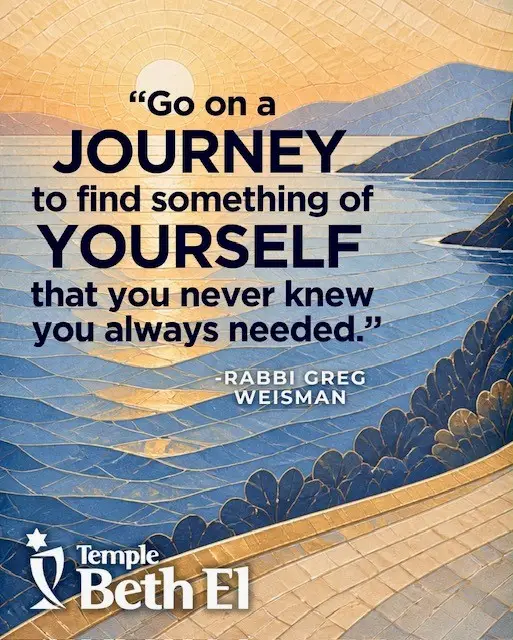
This week we read Parashat Lech L’cha, the story of God calling Abraham to leave the land of his birth, the land of his ancestors, the place he knew well, and to go forth, lech l’cha, to a land that God would show him. The phrase lech l’cha is curious. Lech means “go.” L’cha means “to you.” For centuries, rabbis and scholars have debated the meaning of these two words. Were they merely meant to underscore the importance of the task, as if to say, “You REALLY should go”? Perhaps. But most interpretations suggest that the l’cha implies something about the journey and destination that Abraham needed to experience for his own benefit, that something of himself was waiting for him. In that sense, lech l’cha means “go to yourself”: go on a journey to find something of yourself that you never knew you always needed.
A few weeks ago, we were visited by Dr. Zohar Raviv, an amazing Israeli educator and the leader of Birthright Israel’s educational programming. In a conversation about the origins of Zionism, he reminded us that while Theodor Herzl can be called the father of modern political Zionism, the first Zionist was Abraham. He was the first to feel and answer the call to go to the land of Israel, the land that God promised would be our homeland for all time. Like so many who came after him, Abraham sojourned to, and occasionally from, the land, but from the moment of that call, he and all his descendants were eternally connected to it. When God said to him lech l’cha, God was telling him that there was something of himself in that land, and the only way to know and understand that part was to go there and experience it. As Dr. Raviv reminded us, for the thousands of years since then, Jews have had a special connection to the land of Israel. When we go there, when we engage with what is happening there, when we advocate for Israel and her needs, we activate a part of our Jewish selves that is innate to who we are.
For some of us, it’s the geography: the green of the north in the winter, the deafening quiet of the southern desert, the beaches of Tel Aviv, or the hills of Jerusalem. For others, it’s the knowledge that in walking the land of Israel, we walk paths our ancestors have walked for hundreds and thousands of years, each adding a chapter to our people’s story, including ours. For some, it is the deep spiritual connection to the place where God directed and delivered us, and where the Temple opened a portal to oneness with God that we can only strive to recreate elsewhere. In our time, when Jews around the world feel in peril in ways we have not in a generation, Israel is our modern homeland, where we can be safe and secure, where no one can question our right to live freely as Jews. Every Jew who makes their way to the land of Israel finds a piece of themselves waiting there.
It’s been twenty years since I made my first journey to Israel. I went from Mississippi, on Birthright, and found a love that I did not know I knew how to feel. Since then, every time I have boarded a plane at Ben Gurion Airport, my soul has started the countdown to my return. Sometimes it was a few months, other times a few years. But each time I booked that ticket, I felt the pang of lech l’cha: “Go get yourself there, and there you will find another piece of who you are.”
Shabbat Shalom,

Rabbi Greg Weisman