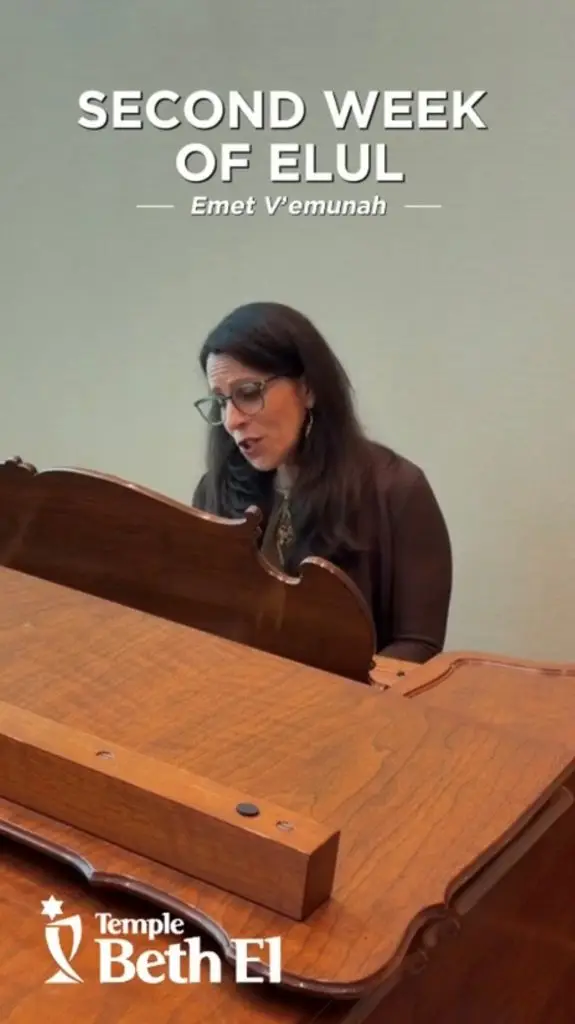
Click here to view a video of Emet V’emunah
with Senior Cantorial Leader Michelle Auslander Cohen
Each day, each moment, we are faced with choices to make. They are often mundane- what to wear, what to eat, whether to scroll on Instagram or pick up a book, relax on the couch or go out for some fresh air and exercise.
As Jews, we also see ourselves as having daily opportunities to make choices of holiness, to bring sanctity into our lives and the lives of those around us. Those opportunities are the mitzvot, the sacred obligations our Torah gives us to care for the vulnerable, to pursue ethical fulfillment, and to connect with the Holy One. In our Torah portion this week, Ki Teitzei, we encounter a litany of these opportunities, 74 in fact; more than in any other portion in the Torah. Each is a unique and interesting opportunity to fulfill God’s teaching, opportunities to do right by someone (or avoid harming them), opportunities to take care of the world around us, opportunities to celebrate the most wonderful moments in our lives, and opportunities to recall some of our people’s most trying times.
Some of the mitzvot, like celebrating Shabbat or welcoming a baby into the covenant of our people are, on their face, holy experiences. But others appear to be mundane: building a guard rail around a building’s roof deck, shooing away a bird before taking eggs from a nest, paying workers in a timely manner when their work has been completed. All are ethically sound. But what makes them holy?
Nachmanides, the great Spanish rabbi of the 1200s, saw the performance of a mitzvah, any mitzvah, not only as the chance to bring some good into the world, but also to heighten our inner, spiritual selves. Fulfilling the wishes of the Author of the Universe were, to him, acts of gratitude that we had been created and that we were given the free will to choose to do right (or not). When we opt to do a mitzvah, he taught, we declare to and for ourselves, “I want to be connected to my people, my tradition, and God.” That doesn’t only please God, it reenergizes our spiritual core. It is in that spiritual energization that we find holiness, even if the act itself seems ordinary.
The 74 mitzvot in Ki Teitzei, and the 613 across the entire Torah, are each wonderful opportunities for holiness. Taken one at a time, they are enticing and feel like something we can accomplish. But taken as an entire set, they begin to feel like a lifelong responsibility that, try as we might, we will all struggle to fulfill. The truth, the emet of our experience is that we will not be able to. No one can. There are simply too many things to do and not enough hours in the day or days in the year or years in our lifetime to do them all.
But, that emet is met with the emunah, the faith that this is not a failure of our devotion to Torah and tradition, but rather a part of the design that the Holy One made us with. We are not meant to be perfect, even if we are meant to aim towards perfection. The fact that God gave us this period of Elul and the coming High Holy Days is evidence of that. Among the mitzvot in our Torah are our opportunities on Yom Kippur to ask for forgiveness, first from those whom we have harmed and second from God for our opportunities not fulfilled. Having given us Torah, God knew we would need to iterate our attempts to fulfill it. So, we are told to take it with emunah, on faith, that God will provide for whatever forgiveness is genuinely sought.
Emet V’emunah – truth and faith.
A couple centuries ago, Rabbi Menachem Mendel Leffin, one of the Mussar masters, noted that our feelings, like fear, anger, or worry, can often be manifestations of deeper thoughts or evidence of spiritual realities. “If worry comes to your heart,” he wrote, “take it as a warning from God who loves you. Examine your deeds and take counsel with those whose advice you seek. When you have fulfilled God’s will, trust God and your serenity will return.”
It’s this time of the year that we are given the gift of the opportunity to examine our deeds and take counsel. During Elul and into the High Holy Days, we ask ourselves which mitzvot were missed opportunities, and which do we know we want to repeat in the year to come. Which do we want to seek out to bring more holiness into our lives, and for which are our souls simply not yet ready. But with emunah that the new year will bring us blessings of life and goodness, we can pursue a path of emet.
What do we need? What do we choose? Now is the time to ask ourselves those questions and search our souls for the answer. Now is the time to seek to find or fashion what will bring us holiness in the new year to come. Now is the time to know that the truth of our limits and the faith that we will nonetheless live lives of holiness should inspire us to seek to be the best versions of ourselves in the new year to come.
Shabbat Shalom,

Rabbi Greg Weisman