Embracing Gratitude
In 1863, America was a nation divided. The Civil War was tearing families apart, communities were grieving, and the future of the nation remained uncertain. In the midst of such divisiveness and pain, President Abraham Lincoln received a letter from Sarah Josepha Hale, Editress of Godey’s Lady’s Book, a popular women’s periodical. For fifteen years she had been writing and petitioning local officials for a fixed day of Thanksgiving to be observed by all as an expression of unity. She advocated for the creation of a custom, some might even say a ritual, for the American people to observe a day devoted to gratitude. She wrote “it needs National recognition and authoritive fixation only, to become permanently, an American institution.” On October 3, 1863, Lincoln issued his historic proclamation establishing a national day of Thanksgiving to be observed on the last Thursday in November.
On that first official Thanksgiving Day, November 26, 1863, Rabbi David Einhorn, one of the pioneering voices of American Reform Judaism, offered a sermon before his congregation, in Philadelphia, urging his community to embrace the new national holiday. Rabbi Einhorn drew from the Torah portion, Vayishlach, the same parsha we read this week, and focused his message on the encounter between two brothers, Jacob and Esau. The story centers on the brothers being reunited after years of separation, rivalry, and deception. The parallels are striking, a nation divided against itself and two brothers standing on opposing sides of a painful history.
Jacob is terrified as he prepares to see his brother. He fears for his life and the lives of his family. In the midst of uncertainty, he pauses and offers words of gratitude to God, acknowledging the blessings that surround him.
קָטֹנְתִּי מִכֹּל הַחֲסָדִים וּמִכָּל־הָאֱמֶת אֲשֶׁר עָשִׂיתָ אֶת־עַבְדֶּךָ
Katonti mikol hachasadim umikol ha’emet asher asita et avdecha.
I am unworthy of all the kindness and faithfulness You have shown Your servant.
(Genesis 32:11)
Jacob’s fear does not diminish his gratitude, nor does his gratitude eliminate his fear. He is capable of holding both.
In his sermon, Rabbi Einhorn urged his congregation to do the same. There is spiritual wisdom in embracing gratitude even when we find ourselves navigating uncertainty and fear. Gratitude does not ask us to deny the brokenness that exists in our world; it asks us to hone our focus and see clearly the goodness that surrounds us.
Judaism teaches we are to begin each day with a spiritual posture of gratitude. Before we even rise from our beds, we recite:
מוֹדֶה אֲנִי לְפָנֶיךָ
Modeh ani l’fanecha.
I give thanks before You.
We continue with Birkhot HaShachar, our morning blessings, and offer praise for daily miracles; the ability to see, to stand upright, to move freely, and to find strength when we are in need. Even the most ordinary experiences of our lives are punctuated by blessings. The rabbis understood that gratitude is cultivated through repetition and intentionality. We become grateful by practicing gratitude.
Every Shabbat, we make a deliberate shift in our liturgical language. We set aside the petitions of our weekday Amidah and turn our hearts toward praise. We shift our attention from what we seek to words of thanksgiving for what we have received. Shabbat is a weekly spiritual practice of embracing gratitude.
When Jacob approaches Esau:
וַיָּרָץ עֵשָׂו לִקְרָאתוֹ וַיְחַבְּקֵהוּ וַיִּפֹּל עַל־צַוָּארָו וַיִּשָּׁקֵהוּ וַיִּבְכּוּ
Vayaratz Esav likrato, vayechabkehu, vayipol al tzavarav, vayishakehu, vayivku.
Esau ran to meet him, embraced him, fell upon his neck, kissed him, and they wept.
(Genesis 33:4)
The Torah shares, with tenderness, the intimacy of their encounter. Their embrace does not erase their history or resolve the complexities of their relationship. Yet, for that moment, they receive one another with love. Jacob says to Esau:
רָאִיתִי פָנֶיךָ כִּרְאֹת פְּנֵי אֱלֹהִים וַתִּרְצֵנִי
Ra’iti fanecha kirot p’nei Elohim vatirtzeini.
Seeing your face is like seeing the face of God, and you have received me favorably.
(Genesis 33:10)
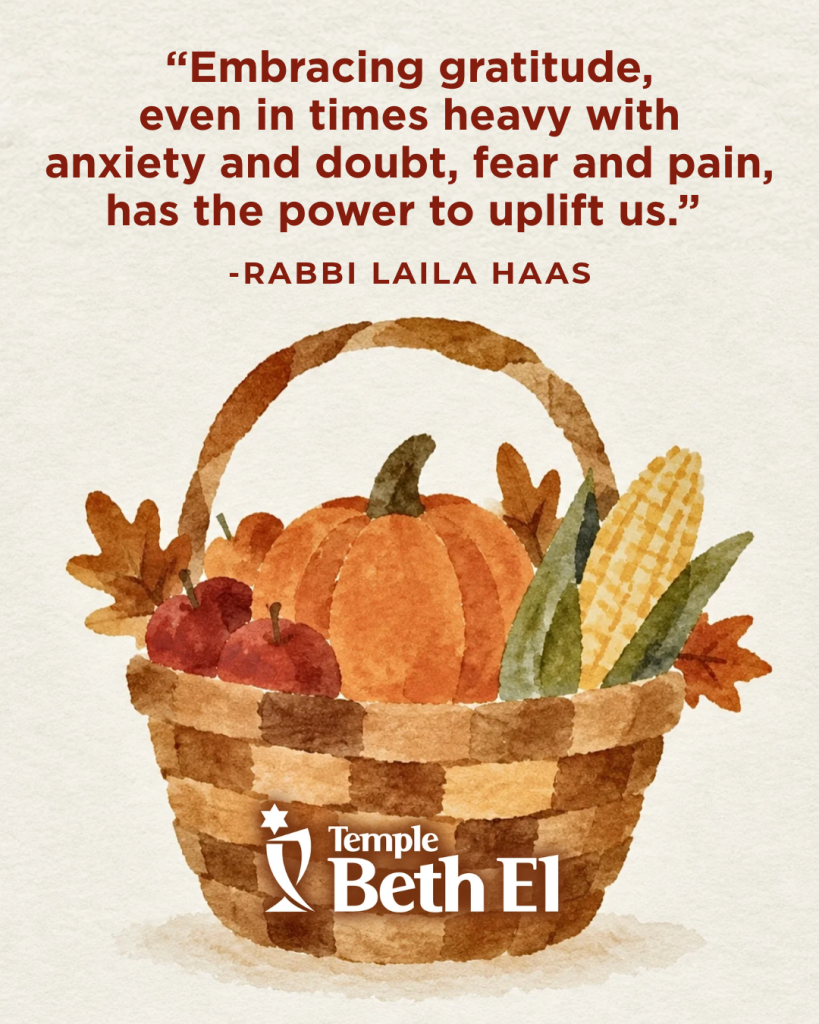
What I love about this moment is that Jacob tells Esau what it means to him to be enveloped by him. To embrace gratitude is to recognize the sacred spark in a moment while we are living it and to share what we are feeling either with the person who has made that moment so meaningful and if we are alone, to pause and feel the power of our grateful spirit. Embracing gratitude, even in times heavy with anxiety and doubt, fear and pain, has the power to uplift us.
This Shabbat, embrace someone you love and linger a little longer than you normally would. Tell them what you appreciate about them, or simply how grateful you are to be together. So often we assume that the people we love know how we feel. Share your words of gratitude and be specific. Share a moment, a memory, or just a few words about how they bring joy and blessing into your life. If you are on your own, wrap your arms around yourself and share a sentiment of gratitude aloud. Fill your soul with thankfulness.
One of the things I am grateful for about our tradition is that it teaches us to embrace gratitude as an active expression of soulful living. It guides us to hold the complexities and uncertainties of our lives while cultivating the spiritual capacity to recognize, embrace, and give voice to the goodness that surrounds us.
I am grateful for all of you and for the sacred community we are blessed to share.
Shabbat Shalom.

Rabbi Laila Haas