Last week, one of my personal heroes, astronaut Jim Lovell, died at the age of 97.
At the end of 1968, a year of intense social and political upheaval – the Tet Offensive in Vietnam, the assassinations of Martin Luther King Jr. and Robert F. Kennedy; Lovell joined Commanders Frank Borman and Bill Anders on a mission that would change human history.
The astronauts of Apollo 8 were the first human beings to orbit the moon. As they sailed past the dark side of the moon, Lovell said, “Then, looking up I saw it – the Earth – a blue and white ball, just above the lunar horizon, 240,000 miles away.”
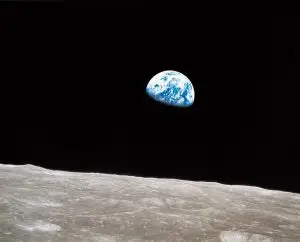
“Then I remembered a saying I often heard: ‘I hope I go to Heaven when I die.’ I suddenly realized that I went to Heaven when I was born! I arrived on a planet with the proper mass to have the gravity to contain water and an atmosphere, the essentials for life…
“In my mind the answer was clear. God gave mankind a stage upon which to perform. How the play ends, is up to us.”
Thousands of years before, as the Israelites prepared to enter the land of Israel, the Torah describes a very similar sentiment.
In Parashat Ekev, the Israelites have arrived on the threshold of the Promised Land. For two generations, the people had suffered trial and torment in order to inherit the land promised to their ancestors.
The land of Israel, Moses declared, is filled with bounty and promise. It is, “a land where you may eat food without stint, where you will lack nothing.” (Deuteronomy 8:9)
But the land was not supposed to be an end in itself. Instead, it was to be the stage on which our people might fulfill its mission and purpose. Possession of the land was contingent on the Israelites’ willingness to live there in accordance with God’s teachings and commandments.
“You shall faithfully observe all the Instruction that I enjoin upon you today, that you may thrive and increase and be able to possess the land the Eternal promised on oath to your fathers.” (Deuteronomy 8:1)
What matters most to God is not the land, but how the Israelites choose to live in it.
“And now, O Israel, what does your God demand of you? Only this: to revere your God, to walk only in divine paths, to love and to serve your God with all your heart and soul.” (Deuteronomy 10:12)
The Torah teaches that the land of Israel was to be the place where we showed humanity the virtues of humility and sensitivity, where we cut away the thickening from around our hearts and released the stiffness from our necks, where we pledged our allegiance to a God who “upholds the cause of the fatherless and the widow, and befriends the stranger, providing food and clothing. You too must befriend the stranger, for you were strangers in the land of Egypt.” (Deuteronomy 10:18-19)
The Holy One declared that we would be blessed to live in the Holy Land only so long as we pledged ourselves to living holy lives.
But from the surface of the moon, the land of Israel can hardly be distinguished from the rest of the earth. The earth itself, Jim Lovell declared, is “a grand oasis in the big vastness of space.”
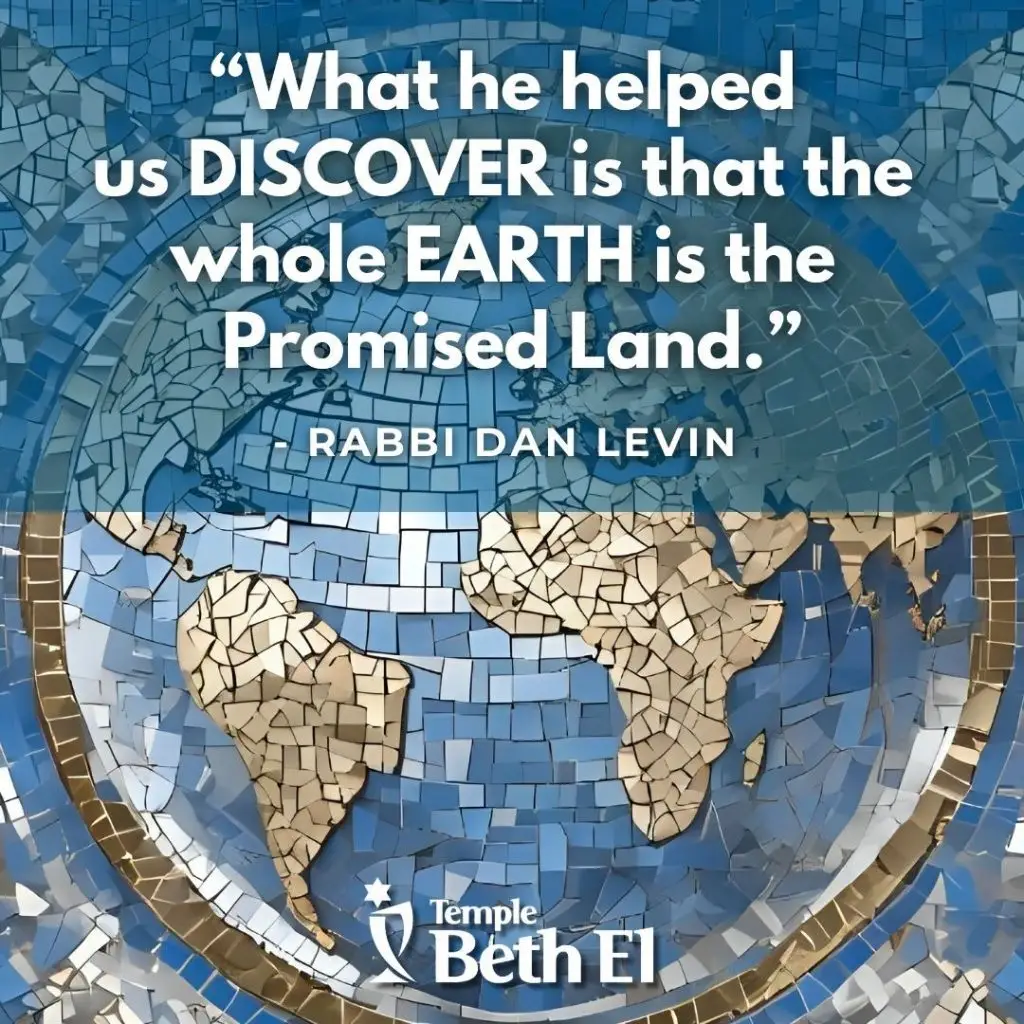
What he helped us discover is that the whole earth is the Promised Land.
It is not only in the land of Israel that we must walk in the divine paths the Torah commands. Indeed, we must devote ourselves to righteousness, to compassion, to justice, and to love in every place on earth we are blessed to live, in every moment of every day.
If, as Moses taught, we impress God’s teaching upon our hearts, teaching it to our children, living a holy life at all times, with pure passion, in word and in deed, then not only will we long endure in the land of Israel, but humanity and holiness will long endure on this good earth.
Shabbat Shalom,

Rabbi Dan Levin
Temple Beth El of Boca Raton