There is an adage we often hear from our more senior friends and family: “Getting older is not for sissies.”
The human vessel is an extraordinary machine. Our daily prayers remind us to be grateful for the finely balanced network of the human body.
But as we age, the body, like all machines, ages along with us.
Our skin gets thinner and our bones more brittle. We lose muscle mass. We lose dexterity. We can’t walk as fast, or run anymore. Our eyesight dims. Our hearing declines. Our valves begin to leak. Our organ function reduces. Our joints lose cartilage. Our recall begins to slip. Our reaction time slows. We can’t think as fast.
It gets harder to remember, harder to learn, harder to move.
A friend of mine recently turned 75. When I called him for his birthday he said, “You know what they don’t tell you about getting older? Everything hurts.”
Living with pain is exhausting. Pain makes you myopic – when you’re in pain, it’s hard to focus on much else.
Going to the theater is harder to enjoy when you can’t see as well. Having dinner with friends is harder when you can’t hear the conversation. Going out isn’t as much fun when walking hurts with every step. And sometimes, the basic elements of living – taking a shower, using the bathroom, going for a walk, become impossible without an aide or a helper.
At the beginning of Parashat Bamidbar, Moses takes a census of the Israelites. Who is counted? “All from twenty years old and upward, all that are able to go forth to war in Israel…” (Numbers 1:3).
So does there come a point in our lives when we are seen as no longer contributing? Is there a point when we no longer “count”?
Too often, we diminish and discount people who are infirm or in their later years. We rush past them when they walk a little slower. We speed past them when they drive more carefully. Too often we make jokes at their expense. We speak to them in a pedantic tone.
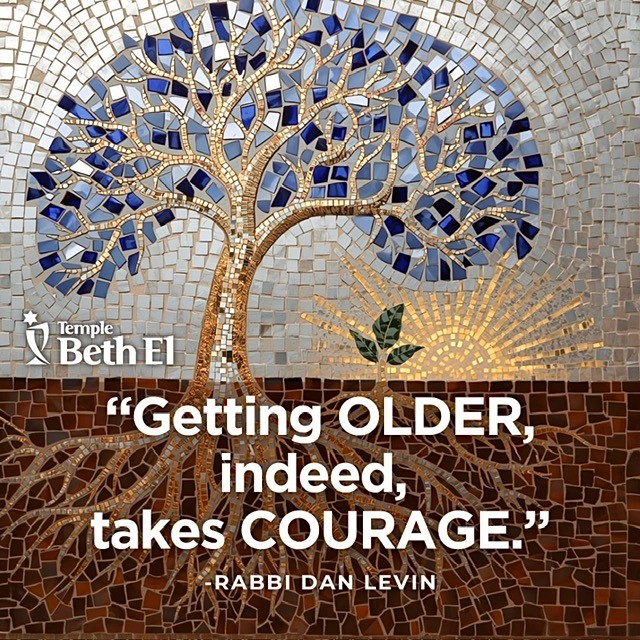
But getting older, indeed, takes courage.
It’s indescribably difficult to let go of the things that once gave life definition and meaning. It’s incomprehensibly hard to lose capacity and independence. It’s extraordinarily challenging to see one’s world become smaller – to miss seeing the people you love because it’s too difficult to travel, to watch the people close to you face illness and decline, to have one’s social calendar fill with funerals and memorials and celebrations of life.
No one wants their daily outings to consist of sitting in a doctor’s waiting room. No one wants to be that person waiting in the wheelchair to board a flight.
When we see older people, too often we forget one essential truth: they once were younger people. Not long ago they could do everything they loved.
They did work that gave them joy and satisfaction. They practiced professions and built careers. They played sports and danced, played musical instruments and made art. They listened to great music and watched beautiful shows. They could fall – to the ground and in love – and get up with ease. They had exciting and thrilling adventures. They rolled their eyes when their children were exasperating. They had great and passionate sex.
And as they aged, they also amassed extraordinary wisdom and experience. They developed a perspective and understanding that can only be borne from age.
Even though they may be older, their needs and wants and desires have not changed.
All people want to love and be loved. All people want to be productive and live with purpose and with meaning. All people want to make a difference. All people want to spend their time doing what brings them joy and satisfaction. All people want to laugh. All people want to be moved.
That never changes. Ever.
We may not count older people in the ranks of our armies, but we count on them to be role models, repositories of memory, fountains of advice, and purveyors of wisdom.
We stand on their shoulders. We walk the paths they paved. We build our lives on the foundations they laid.
We count on them. Because they count.
Shabbat Shalom,

Rabbi Dan Levin
Temple Beth El of Boca Raton