Every year, my dad and my childhood rabbi led the first night seder together at my rabbi’s home. Our families spent the day setting the table and preparing for a meaningful journey reliving our people’s exodus from Egypt. Everyone, all ages, sat around a very large table, read every word of the Haggadah and sang with gusto as my father led us with his booming voice and guitar. Even as children, we were captivated.
When we arrived at the plagues, we placed our cups of wine in the center of our plates and with each plague dipped our finger, placing a drop onto our plates. As we got to the tenth drop, I would look around to see who would lick their finger, tasting the sweetness of the wine, and who wiped it quickly on their napkin, as if to rid themselves of the bitterness of the plagues. Some leaned toward sweetness. Others turned away from the pain.
Such a small gesture, and yet it told an interesting story. When we encounter suffering, our own or others, we respond in different ways. The ritual itself teaches something profound; we diminish our joy in recognition of suffering, then drink from the same glass to find sweetness on our lips again. We hold grief and gratitude, sorrow and sweetness together.
This week, our parsha places us in Egypt with Moses and Aaron preparing to stand before Pharaoh, demanding “let my people go!” Moses returns to the Israelites with what should be the greatest news imaginable. God has heard their cries. Redemption is coming. Freedom is on the horizon.
וַיְדַבֵּר מֹשֶׁה כֵּן אֶל־בְּנֵי יִשְׂרָאֵל וְלֹא שָׁמְעוּ אֶל־מֹשֶׁה מִקֹּצֶר רוּחַ וּמֵעֲבֹדָה קָשָׁה׃
“But when Moses told this to the Israelites, they would not listen to Moses, their spirits crushed by cruel bondage.” (Exodus 6:9)
They didn’t reject Moses’s leadership or experience a lack of faith. Mi-kotzer ruach, their spirits were crushed. The literal translation of the phrase means shortness of breath. Sforno teaches “their present state was so deteriorated by harsh physical and psychological conditions that their hearts could not take in or comprehend the promise of redemption.”
Their souls had no air, no space to imagine anything beyond their current suffering. Slavery had constricted their inner world and their ability to fill their souls with the breath of life. The Israelites are not faithless here; they are spiritually exhausted, unable to make space for the dream of redemption.
On Monday we honor Dr. Martin Luther King Jr., who spoke to those who were weary, beaten down, jailed, threatened and spiritually exhausted. In his “I Have A Dream” speech, he said, “with this faith, we will be able to hew out of the mountain of despair a stone of hope.” What a holy image, from a mountain of despair, heavy and immovable, a single stone of hope will come from it. Not because despair disappears, but from it can come the hope needed to move towards light.
This is the spiritual work of refusing to accept a world of constriction, of kotze ruach, crushed spirits and shortness of breath.
We are blessed to have Rabbi Michael Paley joining us this Shabbat from Budapest. He’ll speak during Shabbat services, focusing on the theme of Jewish resilience and revival and will lead Torah study tomorrow morning at 9:30 am as part of our Wisdom and Wonder series. Tonight, Rabbi Paley will focus on Simon Rawidowicz’s article: “Israel: The Ever-Dying People.”
Rawidowicz argues that every generation of Jews feels as though it might be the last. Antisemitism, expulsions, pogroms, assimilation—it always feels as though we are standing at the edge. That too is kotzer ruach, a collective shortness of breath.
And yet, here we are.
Rabbi Paley will teach how the resilience of the Jewish people has led us to be a people of renewal and revival. Even in times of great suffering and uncertainty, we continue to build community and strengthen one another, even when it feels fragile.
Renewal is taking the first breath. The Israelites did not leap out of Egypt. They walked. Slowly, uncertain, afraid, but they walked forward.
Redemption comes from people who keep showing up in the midst of uncertainty. From those who are ready to take the next step.
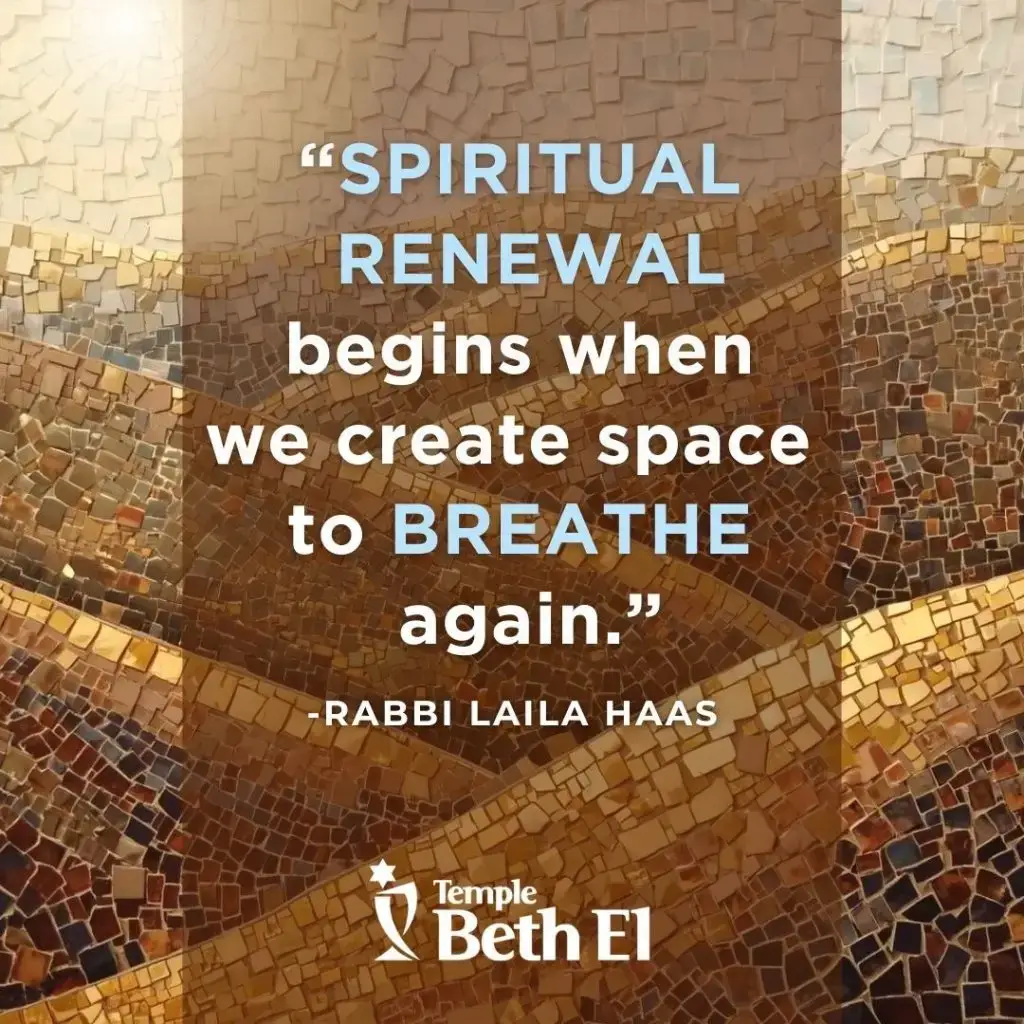
Kotzer ruach, when the spirit is crushed, it needs air. Spiritual renewal begins when we create space to breathe again. Space for song. Space for memory. Space for community. Space for possibility. That is what a soul filled with ruach looks like.
When the world feels heavy, when our spirits feel constricted, when the future feels fragile, we take the next breath. We set our intentions and allow ourselves to dream of the future we hope to create.
Our ancestors could not imagine freedom, and yet they walked toward it. Dr. King had a dream and encouraged others to dream in the face of injustice. At the seder table, after we diminish our joy with drops of wine on our plates, we do not pour fresh wine. We lift the same cup and we drink. Some taste sweetness. Some taste bitterness. But we all drink from a cup that holds both.
This is the work of transforming kotzer ruach to ruach, spirit, again. We do not have to wait for suffering to pass before we seek sweetness. We do not need our breath to come easily before we begin to take deeper breaths. We drink from the diminished cup and discover that even there, sweetness remains.
The ritual teaches us that renewal is not choosing one over the other; it is holding both and drinking from the same cup. May we find the strength to imagine a future wider than our fears. May we taste both the sorrow and the sweetness. And with ruach, spirit, may we walk breath by breath toward the future we dream into being.
Shabbat Shalom.

Rabbi Laila Haas