Earlier this month, I got very sick.
On the last day of a family vacation in Mexico, I began to develop a rash and I woke up feeling incredibly ill. The hotel doctor sent me to the hospital where I was diagnosed with a myriad of possible illnesses.
Most of the people who attempted to care for me did not speak English. Because my fever was so high, they took away my blankets, and I lay there shaking and itching, my body beginning to swell and covered in an ever-worsening rash.
I prayed. I cried. I felt helpless and trapped.
I had never before prayed to God asking, “please let me live.” I felt myself sinking into a place of fear I had never known before. I thought about the words of Rebbe Nachman of Bratzlav: “The whole world is a very narrow bridge, and the most important thing is not to be afraid.”
But I was afraid and those words I had sung so many times made no sense to me. I felt trapped in a narrow place of fear.
My family found an extraordinary company—run by Jewish people—to fly me home. Shmuely and Yossi—two incredibly kind and compassionate medics wearing kippot – from Boca of all places — rescued me. They strapped me onto a stretcher in a tiny plane – so small that you couldn’t even stand up straight in the center aisle.
And now I faced yet another narrow place; I suffer from claustrophobia. Being strapped down on a stretcher in a very small airplane was a tremendous challenge.
I asked God to help me find the strength to face these fears. And in that moment, I began to understand what Rebbe Nachman meant.
Fear itself is a narrow place. Fear can trap us. Fear can paralyze us.
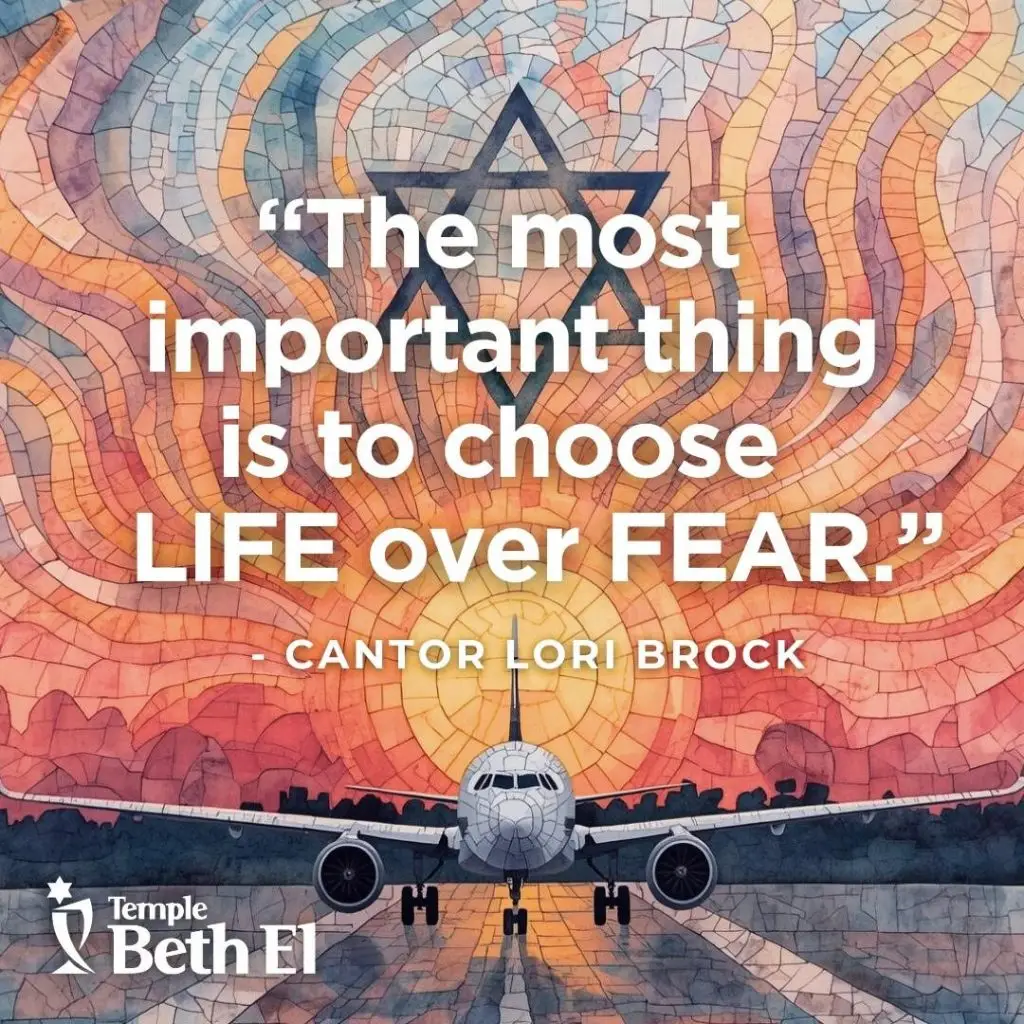
The most important thing is to choose life over fear.
It’s ok to acknowledge the fear but there are times when you have to dig deeper, to find the strength and determination to push through those fears. In those times we need to listen to that still, small voice inside us – that voice of God that speaks from the deepest place in us, that calls us to have faith, to be strong, so that God will give us the power to overcome our fears and escape the narrow places that bind us.
I arrived at Jackson Memorial Hospital, where teams of doctors ran tests—biopsies, cultures and endless blood work. In the days that followed, as the illness progressed, again I felt myself sinking into this narrow place of fear and despair.
Then Rabbi Dan called me.
He told me to close my eyes and picture myself in a place where I was whole and well —where I was my once again my full authentic self. I let myself go to that place, and I felt myself liberated from that fear. I could see beyond the narrow confines of my immediate circumstance, and found the calm to realize I was still me – my body was weak, but my soul was intact. God was there for me.
I started thinking about Shabbat Shira – when we chant the Song of the Sea – the story of the Israelites crossing from slavery to freedom. The Hebrew word for Egypt, Mitzrayim, comes from root: Meitzar which means “narrow place” symbolizing constraint, limitation and spiritual confinement.
In that moment I felt a personal connection to Torah. The Israelites were in a narrow place – trapped in slavery and fear—the fear of leaving, dying and stepping into the unknown.
In moments of fear and despair, how do we find hope? How do we keep from losing our faith?
Rabbi Jonathan Sacks taught:
“Hope is the narrow bridge across which we must walk if we are to pass from slavery to redemption, from the valley of death to the open spaces of new life.”
He reminded us that leaving the narrow place of Egypt is not just a historical event. It is an ongoing, daily, personal—and collective journey toward freedom, responsibility and moral growth. As I began to recover, a little stronger each day, I realized that I too had to cross that narrow bridge of hope and faith in order for my spirit to recover along with my body.
Rabbi Sacks also wrote:
“Faith is a courageous movement into uncertainty, motivated by trust. Conversely, it is only by venturing into uncertainty that it is possible for your trust to grow. Faith is not certainty, but the courage to live with uncertainty.”
May this Shabbat Shira, the Sabbath of Song, remind us that even in our narrow places, there is a path forward. May we find the courage to step into the unknown together, to sing even when the way feels uncertain, and to trust that the sea will open.
Shabbat shalom,
Cantor Lori Brock
Shabbat Shalom,
Cantor Lori Brock