The word “regular” has an interesting history. By the 16th century, drawing from the Old French reguler and the Late Latin regularis, “regular” meant “the opposite of secular … marked or distinguished by steadiness or uniformity in action or practice.”
But I think the word must also have roots in Hebrew. The Hebrew word for “regular” is רָגִיל – Ragil. The root is ר-ג-ל – Regel which means “foot or leg.” The sense is that habits (הֶרְגֵלִים – Hergalim) are actions done regularly, like walking.
In our Torah portion this week, Moses finds himself on his regular walk, shepherding his flock in the mountains when he comes upon something also “regular” and “holy.” He sees a bush engulfed in flame, but the bush remains unconsumed.
“And when God saw that Moses had turned aside to look, God called to him from the bush and said: ‘Do not come any closer! Remove your sandals from your feet (רַגְלֶיךָ – Raglecha), for the place on which you stand is holy ground!’ (Exodus 3:5).”
Rabbi Yosef Rabinowitz of Yampol, a Hasidic sage from 18th century Ukraine, taught that there was much more in God’s demand that Moses take off his shoes. “’Take the shoes off your feet’ – that is, set aside the foolishness of your usual habits (רְגִלוּת – Regilut) …”
Reb Yosef seems to suggest that if we want to feel closer to God, then we need to break out of our regular patterns, to walk in a different way. If we want to elevate the quality of our lives, then we are going to have to adjust our regular behaviors and ways of doing things.
In some ways, this makes sense. Last spring, I visited the Grand Canyon for the first time. It was even more breathtaking than I imagined. Away from my regular routine, the majestic vistas at every turn filled my soul with awe and wonder and gratitude.
But Reb Yosef is trying to teach something else. We don’t need to go to the Grand Canyon to experience God’s presence. If we stop and look, take our shoes off our feet and change our habits, our perspective may change, and we may see that the glory of God’s presence is right there in front of us, in what we would ordinarily think of as “just regular.”
Think of all you have experienced today up until this very moment. That you can breathe. That you can walk. That you can see and hear and think.
The fact is that everything we experience in every moment of every day is a flat-out miracle. A palm frond or a blade of grass, the waves crashing on the beach, the sawgrass and ecology of the Everglades – it’s amazing to think of all the wonders we whiz by in the course of our everyday lives.
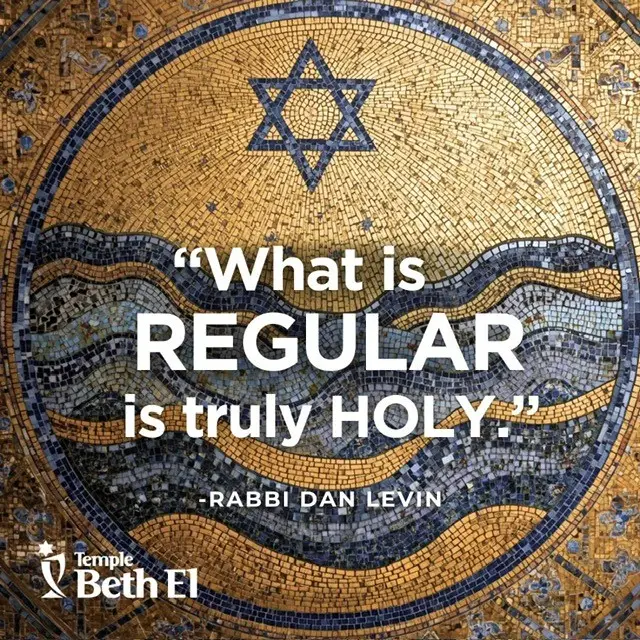
What is regular is truly holy.
Often we find it difficult to see. Financial pressures fill us with worry. Health challenges and pain steal our attention. Loneliness fills us with yearning. All of our anxieties cloud our ability to see.
But if we can push ourselves to stop and look around, to take our shoes off for a moment, we might realize, as Rabbi Yehoshua teaches in Midrash Rabbah, that God appeared to Moses, not in a grand sycamore or carob tree, but in a small thorn-bush, “To teach you that there is no empty place devoid of God’s presence, not even a [lowly] thorn-bush.”
No matter how difficult life may seem, how devoid of meaning our regular routine may appear, we can choose to look at our world anew. If we remove our shoes, shed our entrenched assumptions of what we expect life to be, we might discover new possibilities, new pathways forward, new ways of deriving meaning and joy, even in the constricted confines of our immediate circumstance.
“Then you will see,” Reb Yosef teaches, ‘that ‘the place where you are standing is holy ground’ – in that exact place … precisely from the place where you are, at whatever level you are on … you will be able to attach yourself to God.”
And when our awareness has been heightened, our understanding expanded, our vision clarified, we can lace up our sandals as did Moses, and begin a new journey of purpose, renewal, meaning, and holiness.
Shabbat Shalom,
Rabbi Dan Levin
Temple Beth El of Boca Raton