I find tranquility and inspiration in creative spaces. My mind expands when I’m introduced to a new skill, an exhibit, a new idea, or an immersive experience. Over the past year, I’ve attended workshops that stretch me beyond my skill set, challenge me, and open new pathways of discovery. I’ve stepped into artists’ studios and watched how they listen to their inner voice and bring what lives within them into form through words, stitching, ink, or paint.
Something else intriguing has happened each time I’ve attended one of these workshops. After the demonstration the participants begin talking with one another. First about the process and helping one another. Then as the participants sit at the art tables, working on their creations, they begin to speak about their lives and experiences. The conversations have a different pace because of the setting and the time each person has devoted to being there. There is no urgency and it feels less frenetic. There is depth to the sharing and a recognition of one another’s voice, even in a room where most people didn’t know each other beforehand.
I have been thinking about these moments and what they are expressing about our spiritual needs today. The world we are living in feels fast and fragmented. There is uncertainty and distressing challenges. In the midst of all of this, there is a longing. People are seeking deeper connections. In these spaces, people are rediscovering the power of presence by speaking with one another and engaging in the art of conversation that reaches beneath the surface.
I have watched this same dynamic unfold in our adult learning spaces at Temple. When you enter our Beit Midrash for Lunch and Learn, Parsha Perspectives, Adult B’nai Mitzvah class, Intro to Judaism and Torah Study; people arrive for the learning but what emerges is something deeper.
There is a willingness to linger, to reflect, to speak not only from the mind, but from somewhere more internal. Questions that have long remained unspoken find their way into the room. A kind of inner listening begins to take place. People follow a thread of discovery seeking to understand themselves more fully, to make meaning of what they have been carrying and to give voice to who they are and who they are becoming.
And then, in the act of sharing, something shifts.
What begins as learning becomes relationship. What begins as a class becomes, in its own way, an Ohel Moed, a Tent of Meeting. People who entered as individuals begin to form something more. They show up for one another. They sit together in services. They support and care for one another. Community takes shape through openness and meaningful sharing. It’s spiritually uplifting and inspiring to experience.
This Shabbat, we begin a new book of Torah: Sefer Vayikra, the Book of Leviticus.
The opening verse of the parsha reads:
וַיִּקְרָא אֶל־מֹשֶׁה וַיְדַבֵּר יְהֹוָה אֵלָיו מֵאֹהֶל מוֹעֵד לֵאמֹר׃
“And God called out to Moses and spoke to him from the Tent of Meeting, saying…”
In this one line, three different words are used for communication:
וַיִּקְרָא vayikra— called
וַיְדַבֵּר vayedaber— spoke
לֵאמֹר l’emor— saying
It all unfolds מֵאֹהֶל מוֹעֵד from the Tent of Meeting. The Tent of Meeting was not merely a physical structure. It was a space of encounter. A space entered with openness, humility and perhaps even to be changed. Within that space, the Torah offers us a kind of relational map: Call. Speak. Respond. It seems simple but it’s layered.
וַיִּקְרָא—Call. Before anything meaningful can be shared, there must be an act of reaching toward another. Not to persuade or assert, but simply to open the possibility of connection. In the Torah, the word, וַיִּקְרָא is written with a very small letter alef at the end. One suggestion is that this call requires humility, to make ourselves a little smaller, to invite others in and create space for meaningful engagement.
וַיְדַבֵּר—Speech. Real speech asks something of us: honesty, presence, and the willingness to be vulnerable. Authentic speech requires time and patience. Being intentional with our words matters as they have the power to build or fracture, open or close, begin or end.
לֵאמֹר—Response. A conversation becomes whole when there is space for the other to speak, to be heard, and enter into the exchange. So much of what we long for is not only the ability to express ourselves, but the experience of being received.
Our tradition offers a learning model for this, chevruta (pairs), two people sitting across from one another, engaged in study. In pairs, you question, challenge and listen to each other’s perspective. You learn from one another. In chevruta, we do not speak at one another, but with one another.
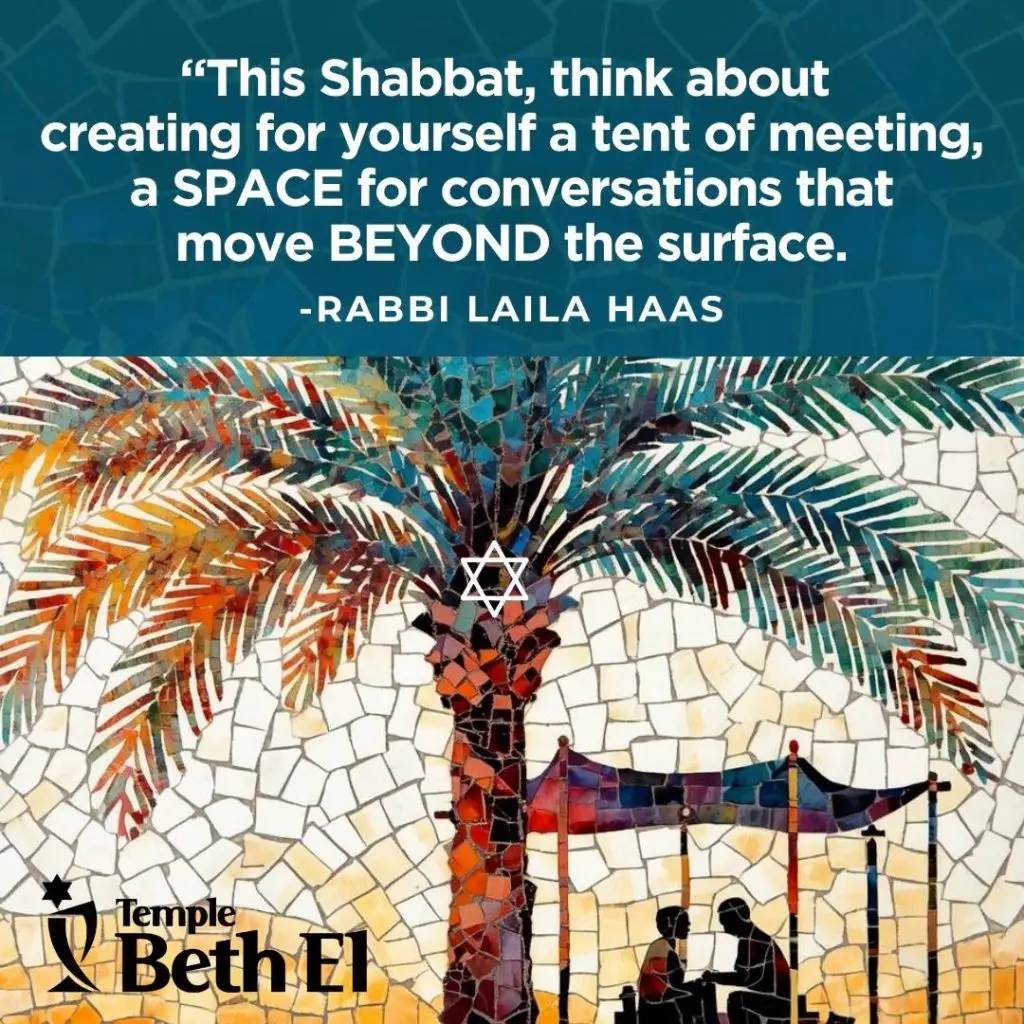
This Shabbat, think about creating for yourself a tent of meeting, a space for conversations that move beyond the surface. Offer yourself the opportunity to be known and to know someone else more deeply. Rabbi Abraham Joshua Heschel taught, “Shabbat is about time rather than space” so make sure you set aside quality time to meaningfully engage with someone else, do not be rushed or feel pulled.
Reflect not only on what you say, but on the space from which you speak. What is your posture when you encounter the other person? Are you guarded, reactive, certain? Create room for curiosity, presence, and vulnerability.
Ask a powerful question. Stay present long enough to truly hear the response. Allow yourself to move, even slightly, beyond the surface, toward deeper connection. These are the spaces where people feel safe enough to speak, open enough to listen, and courageous enough to grow.
You will find the experience at your tent of meeting meaningful and enriching. Connecting to one another on a deeper level can help us feel grounded, balanced and inspired.
Shabbat Shalom.

Rabbi Laila Haas