Recently, I find myself confronting a strange and unfamiliar feeling – fear.
I’ve never been a particularly fearful person. As a kid, I would climb high trees, jump off the deck in the back of my house; and as a teen, let’s just say I would push the envelope a bit more than I should have.
But these days, those butterflies in my stomach seem to visit more regularly. As AI grows ever more powerful, as the world ignores the perils of a warming planet, as thousands of missiles pierce the skies of the State of Israel, with too many destroying buildings and lives on the ground, as antisemitic and anti-Zionist hatred in our country and around the world explodes exponentially – I have to admit to a growing sense of worry, and dread, and fear.
The period between Passover and the Festival of Shavuot in our tradition is called the Omer. Traditionally, following Passover, the grain harvest would begin. Fifty days later, the Torah teaches we bring an Omer, a measure of the first fruits of our crops to the Temple to offer thanks for the blessings of a good harvest.
The rabbis saw this fifty-day period as an echo of our people’s journey through the wilderness, from our liberation from slavery in Egypt to our arrival at Mount Sinai. We count each day of the Omer as we anticipate our annual remembrance of meeting the Author of the Universe, and receiving from God the gift of Torah.
The great master of Jewish mysticism, Rabbi Isaac Luria linked each of the seven weeks of the Omer to one of the seven lower Sefirot – the emanations of God’s presence that links our world to God’s. Last week was Chesed – loving kindness. This second week is Gevurah – strength or power.
When we witness the awesome power that belongs to God, it arouses in us a sense of awe and wonder – and a little bit of fear. The swirling power of a hurricane forces us to rethink our relative strength. The roar of a wildfire compels us to question our safety.
Fear is natural. When we confront threats to our well-being, or situations we cannot control, it is only natural to be afraid.
The prophet Job teaches, “Fear of God is wisdom.” (Job 28:28). Rabbi Menachem Nahum of Chernobyl taught that “fears are nothing more than messengers of God.”
So when fear arrives, what is it that God is trying to tell us? What wisdom can we glean from fear?
This week astronauts ventured further from Planet Earth than any human beings in history. Circling the moon reminded us that it was nearly 60 years ago in December of 1968, Apollo 8 was the first mission where humanity first left earth’s orbit.
Astronaut Jim Lovell, looking back at the earth, remarked, “I remembered a saying I often heard: ‘I hope I go to Heaven when I die.’ I suddenly realized that I went to Heaven when I was born!” Venturing away from our home reminds us of the miracle that is our world, a wondrous, fragile blue ball that somehow has the capacity to nurture and sustain life.
“In my mind the answer was clear. God gave mankind a stage upon which to perform. How the play ends, is up to us.”
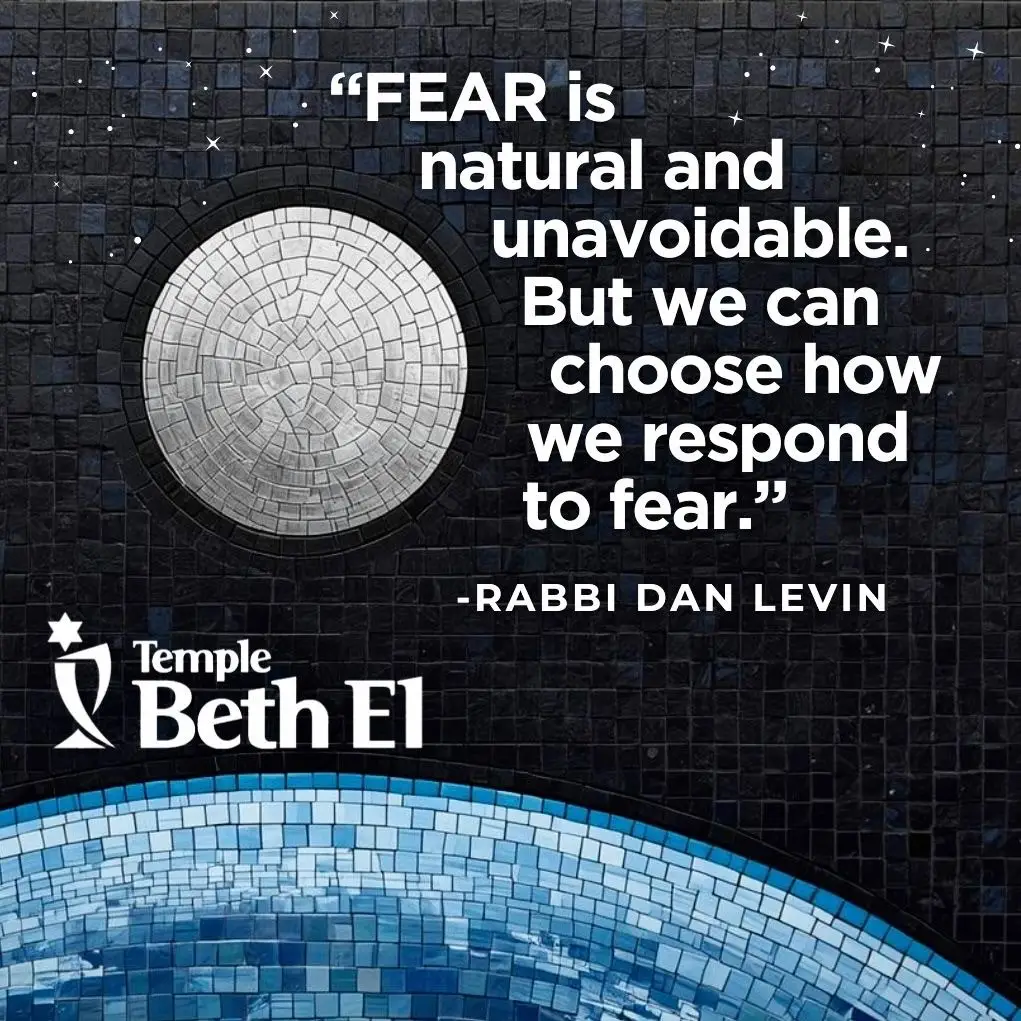
Fear is natural and unavoidable. But we can choose how we respond to fear.
Fear can demoralize us when we confront our fragile smallness. Or fear can rouse in us awe and wonder and gratitude.
Fear can close our minds and harden our hearts with ignorance and hatred. Or fear can open our minds and soften our hearts with curiosity and love.
Fear can drive us toward selfishness and greed. Or fear can inspire us to selflessness and generosity.
Fear can drive us to demean and persecute each other. Or fear can inspire us to understand and nurture each other.
Fear can drive us to destroy, or fear can inspire us to build.
Artemis astronaut Victor Glover remarked this week, “… from up here … Homo Sapiens, all of us, no matter where you’re from or what you look like, we’re all one people.”
The book of Proverbs teaches: “Happy is the one who constantly fears.” (Proverbs 28:14). And happy we will be if our fears drive us toward each other, to understand and lift up each other, and inspire us to build together a world of love and peace.”
Shabbat Shalom,

Rabbi Dan Levin
Temple Beth El of Boca Raton