In Jewish tradition, there are three major festivals: Pesach, Shavuot, and Sukkot.
Two other holidays are called the minor festivals: Purim and Chanukah.
For us, Chanukah doesn’t feel like a minor festival. It is among the most popular and practiced of Jewish observances.
The sages teach that the minor festivals – Purim and Chanukah – celebrate our survival as Jews. Purim and The Book of Esther tells the story of how we managed to evade a genocidal campaign to wipe our people off the Persian map. It is a story of physical survival.
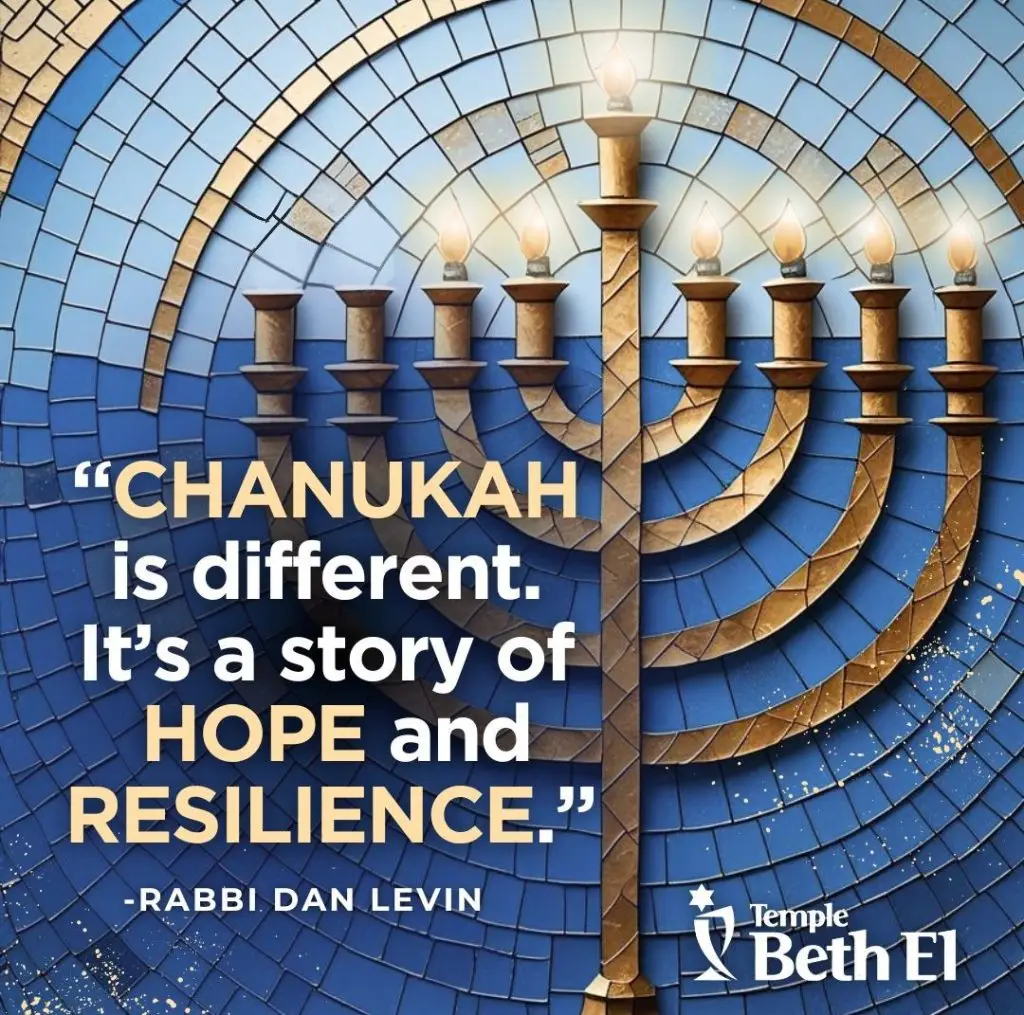
Chanukah is different. It’s a story of hope and resilience. It’s a story of spiritual survival.
Antiochus did not seek the destruction of the Jews, but the destruction of Judaism. He made a very simple proposition. I will let you live and leave you in peace. All you have to do is give up everything you believe in. Forsake Torah and tradition, renounce your ethical mandates and moral principles, and everything will be fine.
I’ll give you your life, Antiochus offered. Just sell me your soul.
The Hebrew word חנוכה – Chanukah means dedication. And spiritually, Chanukah calls us to dedicate more than an ancient temple.
In ancient times, as the Israelites wandered in the wilderness, they would pitch their tents and set up the Tabernacle – the Mishkan. The Mishkan was just a tent, just a collection of wooden planks, metal rods, clasps and rings, fabric and furnishings.
But when the Priests kindled the light of the Menorah, something changed. A simple structure was made holy. By lighting the lamps, the priests dedicated that tent to be a vessel built in service to God, a place where everyone could come to find holiness.
It was the place to which we would come in thanksgiving for good fortune and gratitude for sustenance and plenty. It was the place to which we would turn in repentance for our misdeeds, and to atone from our sins. It was the place where God’s light could be found in the midst of the darkness, where we could find clarity and direction. Where is it we are supposed to go? What is it we are supposed to do? Who is it that I am supposed to be?
The Slonimer Rebbe, Rav Shalom Noach Berezovsky, teaches that in the story of Chanukah, God shows us that even in the bleakest of moments, a small flask of pure holiness remains inside with which we can light the future.
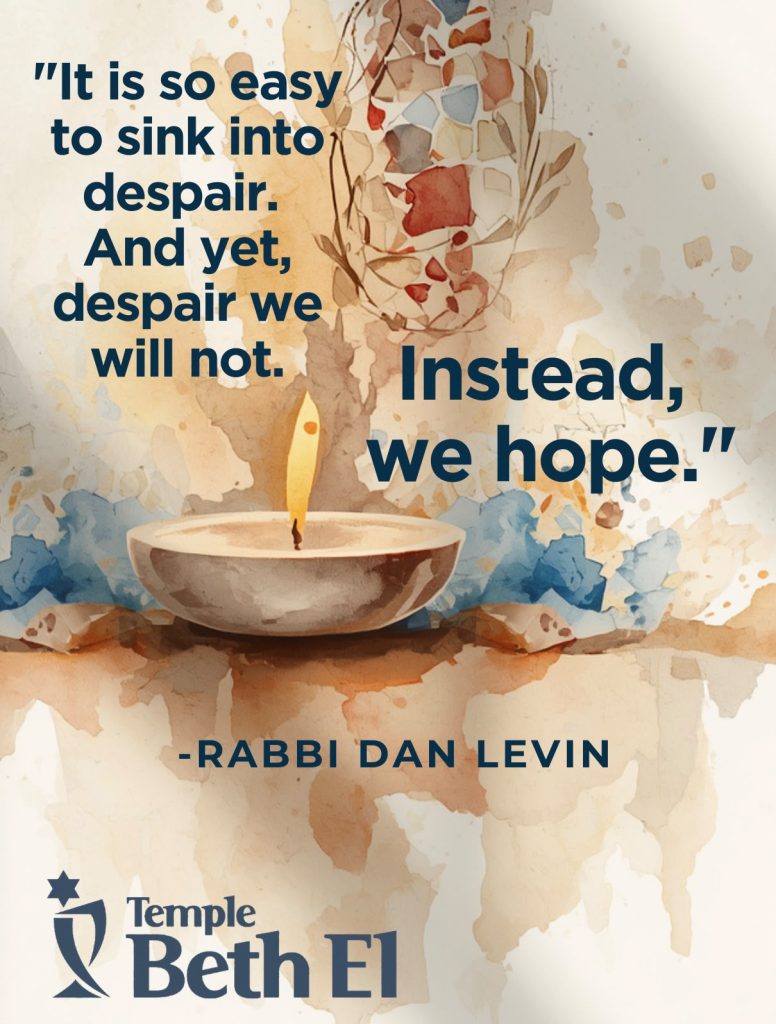
The world outside may be broken, and our inner world may be shattered, but even then, when despair darkens the soul, the smallest cruse of hope can be the fuel which lights our path forward.
When Antiochus extinguished the light of the Menorah, he committed the gravest desecration possible. He not only sought to banish the light of God’s presence from our midst, he sought to snuff out the inner light of hope and faith inside the souls of the people he conquered.
But because we held onto hope and faith, that light was never extinguished. It was rekindled by the Maccabees when they rededicated the Temple. It was rekindled by the sages when they authored a new Judaism after the destruction of the Temple. It was rekindled by Jews who rebuilt their lives after every marauding crusade, after every inhuman inquisition, after every brutal expulsion, after every murderous pogrom, and after the inferno of the Holocaust.
There may be no more Temple in Jerusalem, and no more Menorah to illumine it, but the light of God’s presence still illuminates our souls. And as the Slonimer Rebbe teaches: “There is nothing more precious to a Jew than that light.”
When we draw on that small cruse of hope and faith, we can kindle a flame inside that will restore us to hope, directing us to a path of life filled with meaning and purpose and holiness.
On this Shabbat in Chanukah, as the days grow darker in every sense, let us draw on the reservoirs of hope and conviction we store deep inside ourselves, knowing it will be just the right amount of fuel to illuminate the world forever with the light of wisdom and understanding, compassion and justice, of goodness and peace.
Shabbat Shalom,
Rabbi Dan Levin
Temple Beth El of Boca Raton