In this week’s Torah portion, Chol HaMoed Pesach, we read a moving exchange between Moses and God. The journey from Sinai into the great unknown of the wilderness is about to begin. Moses said to God, “See, You say to me, ‘Lead this people forward,’ but You have not made known to me whom You will send with me…Unless You, God, go in the lead, do not make us leave this place. For how shall it be known that Your people have gained Your favor unless You go with us?”(Exodus 33:12-16)
As I read this text, I see the warm desert wind blowing through Moses’ hair and his feet covered in desert dust. I can see him standing atop Mount Sinai with his face towards the heavens, eyes closed and his arms reaching upwards. As he begins to speak, he raises up on his tiptoes to get just a bit closer and whispers his plea into the ear of God.
For me, the words he utters are so personal. Moses knows the journey ahead will require more of him. He knows the journey will be demanding and he is in need of balance and strength. He doesn’t know the exact coordinates of the route nor does he know what he will see or experience along the way but what he does know is that he needs a spiritual compass to accompany him. Moses seeks the presence of God to accompany him as he prepares to take his first step with intention.
This week we began counting the Omer, a spiritual journey, made step by intentional step, day by day, as we count upward from Passover toward Shavuot, from liberation to revelation. If you aren’t already, I encourage you to follow the weekly Omer learning, shared by email, that Rabbi Rabishaw has so beautifully created for us as a temple family. Incorporate these beautiful teachings into the routine of your lives over the next 44 days.
The Omer is not merely about counting days but about “making days count.” Through this daily practice, we cultivate presence and intentionality. We sanctify time itself, affirming that each day, each step, each breath on our journey toward revelation matters.
Our sages taught that in counting the Omer, “we are not only counting toward the day of receiving the Torah, but the counting itself is also Torah.” The process contains wisdom; the journey itself is sacred. We count each day in ascending order, moving upwards towards the mountain top.
When we think of climbing, we often need a ladder, I do at least. The ladder is a tool needed to reach for things beyond our grasp and it allows us access to spaces out of sight. The counting of the Omer is like a ladder, a tool to help us reach that which is just beyond ourselves. Each rung of this ladder, each day of counting, represents a stage in our spiritual development. Each step up the ladder leads us to our Sinai, a place where we can access inspiration, insight, wisdom and clarity.
Alden Solovy writes “The ladder connecting heaven and earth is near, so near. If only you would turn to look, to notice that holiness surrounds us, to see the invitation to walk with God in this life, exactly as you are. Not an angel but a human, carrying the breath of the Divine inside your heart.”
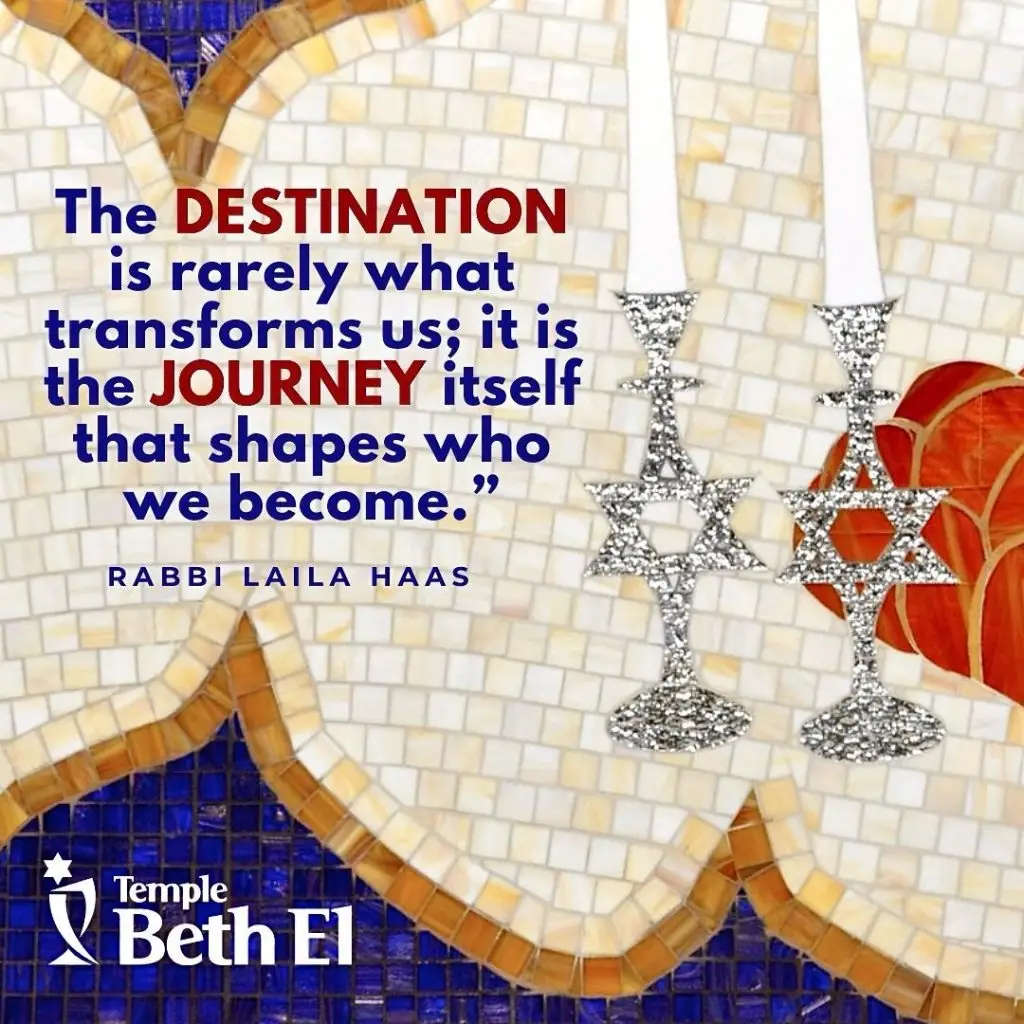
Our personal journeys, whether physical or spiritual, lead to unexpected places and wonderful discoveries. Martin Buber taught “every journey has secret destinations of which the traveler is unaware.” These hidden destinations can be new insights, spiritual growth, or even lead to a shift in perspective. The destination is rarely what transforms us; it is the journey itself that shapes who we become.
When our ancestors journeyed upward to Jerusalem for the festivals, they physically climbed up the road to the holy city. They spiritually prepared themselves by singing the words known as Shir HaMa’alot, Songs of Ascent, Psalms 120-134. On Shabbat we begin Birkat Hamazon, the grace after meals, with one of these Psalms. It is a beautiful representation of this moment in Jewish time as we count each step of our Omer journey upwards to Sinai.
Psalm 126. A song of ascents. When God restored the exiles to Zion it seemed like a dream. Our mouths were filled with laughter, our tongues with joyful song. Then they said among the nations: “God has done great things for them.” Yes, God is doing great things for us, and we are joyful. Restore our fortunes, O God, as streams revive the desert. Then those who have sown in tears shall reap in joy. Those who go forth weeping, carrying bags of seeds, shall come home with shouts of joy, bearing their sheaves.
As we ascend may we find inspiration in unexpected spaces and, like Moses, invite the presence of the Divine to accompany us along our way.
Shabbat Shalom!

Rabbi Laila Haas