There’s a story told about a rabbi whose students once asked him, “What does it mean to be a truly devoted Jewish person?”
The rabbi answered with an image:
“A devoted Jewish person is like a lamplighter, someone who walks through the darkness carrying a flame, going from lamp to lamp, lighting each one. And he knows the flame is not his, it’s something he carries to bring light to others.”
The students then pushed him. “What if the lamp is far away, in a desert?”
“Then you go and light it,” he said.
“And what if it’s in the middle of the sea?”
“Then you dive in and light it anyway.”
They paused and said, “But we don’t see any lamps.”
And the rabbi replied, “That’s because you haven’t yet learned how to see them.”
So they asked, “How do we learn?”
He said, “Start with yourself. Refine who you are. Because when you become more open, more compassionate, more aware, you begin to see the light in others. And once you see it, you can help bring it to life.”
I begin with this story because today is Rosh Chodesh Iyar, אייר, the first day of a new Hebrew month. The word Iyar is connected to the Hebrew word for light, אור, ohr. A month symbolic of light, of divine radiance, and of transformation.
This month comes just after our celebration of Passover, when the Jewish people left Egypt and began a new journey, a new chapter. And during this month, we live in that in-between space, that transition between Egypt and Sinai. Between bondage and freedom.
Because Iyar sits between two of our most defining moments, Passover and Shavuot. From the story of slavery to freedom, to the receiving of the Torah, our guidebook for life.
The rabbis also call this the month of healing. They hear it in the month’s name as an acronym: אני יי רופאך, “I am the L-rd who heals you.” After the hardship of Egypt, after the narrowness and the strain, this is the moment when healing begins. A chance to take a breath. To release what we’ve been carrying. To tend to the parts of ourselves that need care and attention.
Because we cannot fully receive what is ahead of us, we cannot stand at Sinai in our fullest sense, until we begin that work of healing.
In that spirit, I invite you to consider the following:
What parts of you need care and attention this month?
What parts of your being need healing?
And in tending to those places within yourself, how might you begin to spread more light around you?
Because that is where the story returns to us.
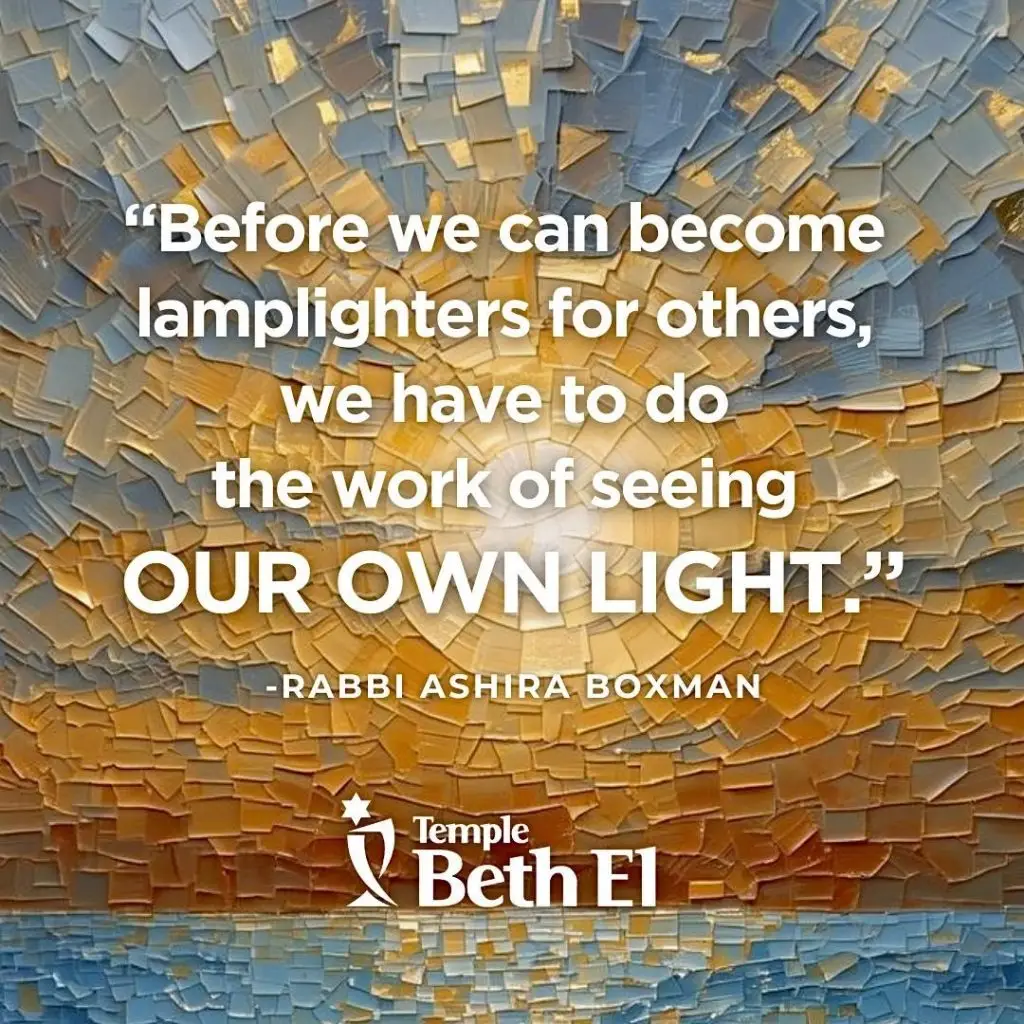
Before we can become lamplighters for others, we have to do the work of seeing our own light. Of softening ourselves enough to notice it. Of tending to it so it can actually shine.
And Shabbat gives us that space.
A pause in the week to step back from the noise and the doing, and to simply be. To reconnect with ourselves. To heal, even just a little. And in that space, to remember that the flame we carry was never only for us.
So may this Shabbat, and this new month of Iyar, a month of אור, be a time of gentle healing. A time to notice the light within you. And from that place, may we each find our way to becoming lamplighters, bringing that light into the lives of others.
Shabbat Shalom,
Rabbi Ashira Boxman