Last night I asked Will, my husband, “Is there something special about the number 42?”
Without hesitation, he replied, “42 is the answer to the ultimate question of life, the universe, and everything.”
“No, seriously, you were a math major,” I didn’t relent, “does the number have mathematical significance?”
He left the room—and returned moments later wearing a t-shirt. On it was a Venn diagram with three circles labeled Life, The Universe, and Everything. And in the center where all three circles intersect, was the number, 42.
For those as unfamiliar as I was, this is a reference to Douglas Adams’ science fiction classic, The Hitchhiker’s Guide to the Galaxy (1979). At first, I laughed pretty hard. So many questions swirled in my mind, the first being, why did he own this shirt? But then I was intrigued. Once again, Will’s love of sci-fi and my passion for Torah intersected and I was led on a journey of discovery!
The Hitchhiker’s Guide to the Galaxy, a satirical commentary on the quest for meaning, follows a character seeking the answer to life, everything, and the universe. His journey leads him to a supercomputer built to solve the riddle of existence. After seven and a half million years of calculation, it finally produces an answer: 42.
42? I wonder if Douglas Adams was influenced by the verses of this week’s double Torah portion, Matot-Masei, which lists, in detail, the 42 encampments the Israelites made in the desert from Egypt to the Promised Land. The Torah could have said, “The Israelites wandered for 40 years and arrived.” Instead, every pause and every departure are named.
We often speak of life as a journey full of movement and change, uncertainty, discovery, joy, fear, growth, love and loss. What we learn from the detailed listing of the 42 stops is that it’s not just the movement that matters; it’s the pauses, too.
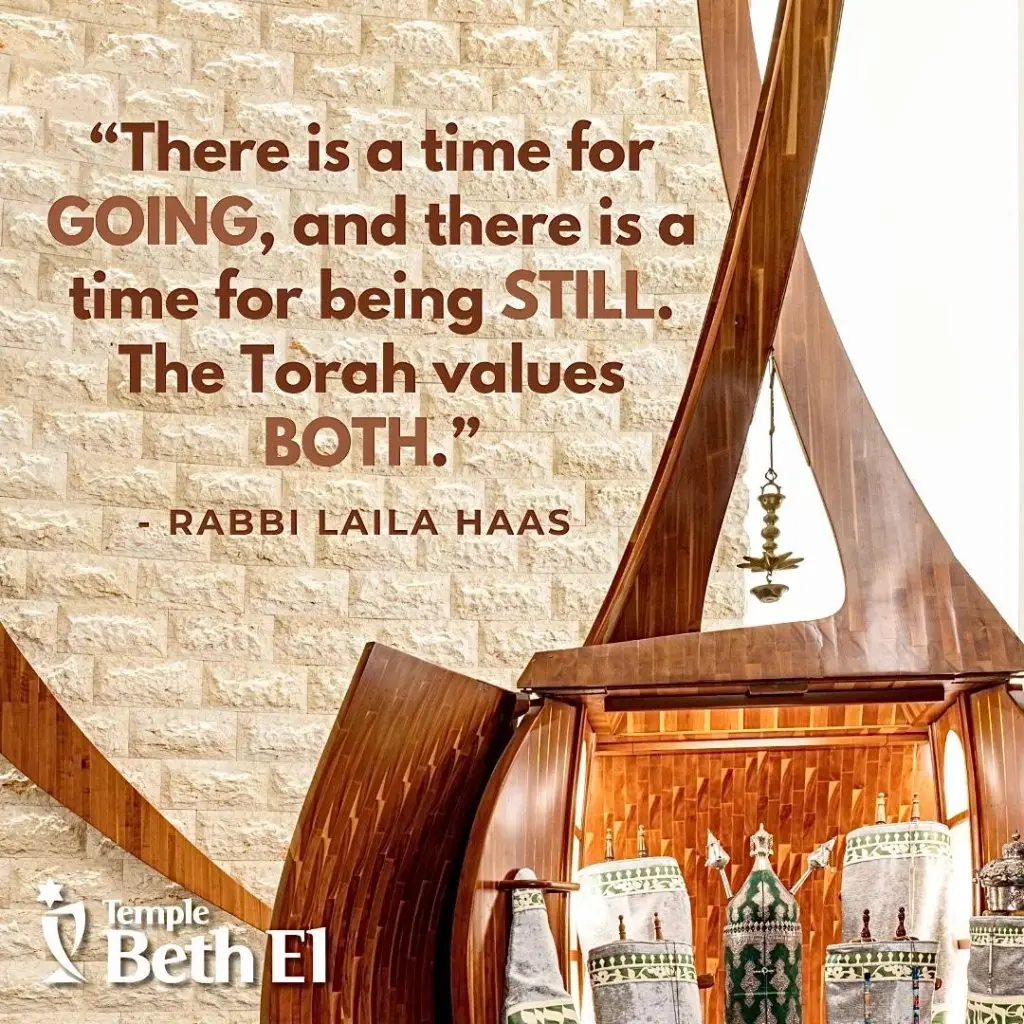
The pauses are where reflection happens. Where we breathe. Where we notice how far we’ve come, what we’ve carried, what we’ve learned. There is a time for going, and there is a time for being still. The Torah values both.
Rabbi Jonathan Sacks taught, “The dialectic between setting out and encamping, walking and standing still, is part of the rhythm of Jewish life…In life, there are journeys and encampments. Without the encampments, we suffer burnout. Without the journey, we do not grow. Without movement, there’s no growth. Without rest, there’s no strength. Life calls us to be both journeyers and dwellers.”
Two weeks ago, Daniella Gilboa, one of the Israeli hostages freed after 477 days of captivity, shared that she had undergone surgery to remove a bullet stuck in her ankle since October 7th. She delayed the procedure for months after her release. On her Instagram account she shared, “I kept the bullet inside me for all those months because every step reminded me to be grateful—for God’s protection, for the friends who stood by me, for my life.” The bullet was a constant reminder of her journey. The months between returning home and her surgery she lived within the pause, reflecting on how the steps of her journey from captivity to redemption carried both pain and hope. And now, with strengthened steps, she begins again.
Her powerful story reminded me of Alvin Fine’s beautiful poem, “Life is a Journey”. The cadence of the poem mimics the steps that we take along our life path. In thinking about the Torah’s message this week and Danielle’s strength my heart was drawn to the concluding lines of the poem:
“Looking backwards or ahead,
We see that victory lies not
At some high point along the way
But in having made the journey
Step by step,
A sacred pilgrimage.”
All due respect to the supercomputer, 42 is not the answer to life, the universe and everything. For me, the number 42 serves as a reminder that the journey of our lives, made step by step, is a holy endeavor. Counting the 42 stops along the Israelites journey teaches us to value not only our forward motion but the power that rests within the pauses we experience along the way.
As we prepare to welcome Shabbat, pause and reflect on the stops you’ve made along your journey, so far. Think about what you’ve learned, how you’ve grown and ready yourself to embark once again, renewed.
As we close the Book of Bamidbar, we pause before beginning the next book of Torah and say: Chazak, Chazak, V’nitchazek! Let us be strong, let us be strong, and let us strengthen one another!
Shabbat Shalom,

Rabbi Laila Haas