A few weeks ago, I was making Asher breakfast. He was sitting at the kitchen table building a Lego creation, his sweet little hands carefully placing each tiny piece exactly where he imagined it should go. Without looking up, totally focused on the Lego bricks, he said: “Mom, if you built me, and your mom built you, who built God?”
It was 7:30 in the morning. I was only one cup of coffee in. Suddenly our kitchen had transformed into a Beit Midrash, with a theological question being held up by a Lego-wielding five-year-old. Following the pedagogy of our tradition, I answered his question with a question: “Who do you think built God?”
He looked at the brick in his hand, placed it carefully on top of the others, and said, “I think the Jewish people built God.” Then, before I could say anything, he snapped the final piece onto his creation and zoomed off, flying his Lego starship around the room.
What he felt in his hands as he built his Lego world is at the heart of what it means to be human. We are both created and creators. We receive the world and we shape it. We are made in God’s image, and yet through our stories, our laws and our questions, we build our understanding of who God is and God’s place in the world. I love a tradition that insists that everyone, regardless of age or stage, has the power to teach and the blessing to learn.
This Shabbat, we welcome Rabbi Dr. Rachel Mikva as our Wisdom and Wonder scholar. Rabbi Mikva is the Herman E. Schaalman Professor of Jewish Studies at Chicago Theological Seminary, and her work explores the question, “What does it mean to be human?” across Judaism, Christianity, and Islam. She will offer her insights from the bima this evening and I hope you will be at Torah study tomorrow morning at 9:30 am to learn with her.
She joins us for Shabbat Mishpatim as we move from the thunder and lightning of Sinai to the formulation of laws to govern us as a society. The Torah portion focuses on laws about property, violence and restitution, widows and orphans and strangers. As we look deeper, these laws are asking us to explore how human nature guides us as we construct the world around us and informs the policies that govern us.
The formulation of laws responds to the complexity of humanity and human behavior. We act intentionally and accidentally, we harm and we heal, we require both justice and mercy. The Torah could have ignored the vulnerable. But instead it repeats: you shall not wrong the stranger, the widow, and the orphan. It insists that to be human means to see the humanity in others. Even in ancient laws about servitude it places limits, demands dignity, and requires rest. It keeps insisting human beings are not things, we are created b’tzelem Elohim, in the divine image.
There’s a midrash that imagines the moment before God created humanity. The angels were divided. Chesed, lovingkindness, said, “Create them! They will perform acts of lovingkindness.” Emet, truth, said, “Don’t create them. They will be full of falsehood.” Tzedek, justice, said, “Create them! They will do justice.” Shalom, peace, said, “Don’t create them. They will be full of strife.” What did God do? God took Truth and threw it to the ground. And then God created human beings anyway.
We are created knowing we will lie and create strife. We are created knowing we will love and pursue justice. We are capable of both the sublime and the tragic. Rabbi Leibele Eiger taught: “God only created the beginning and left the rest to humankind.”
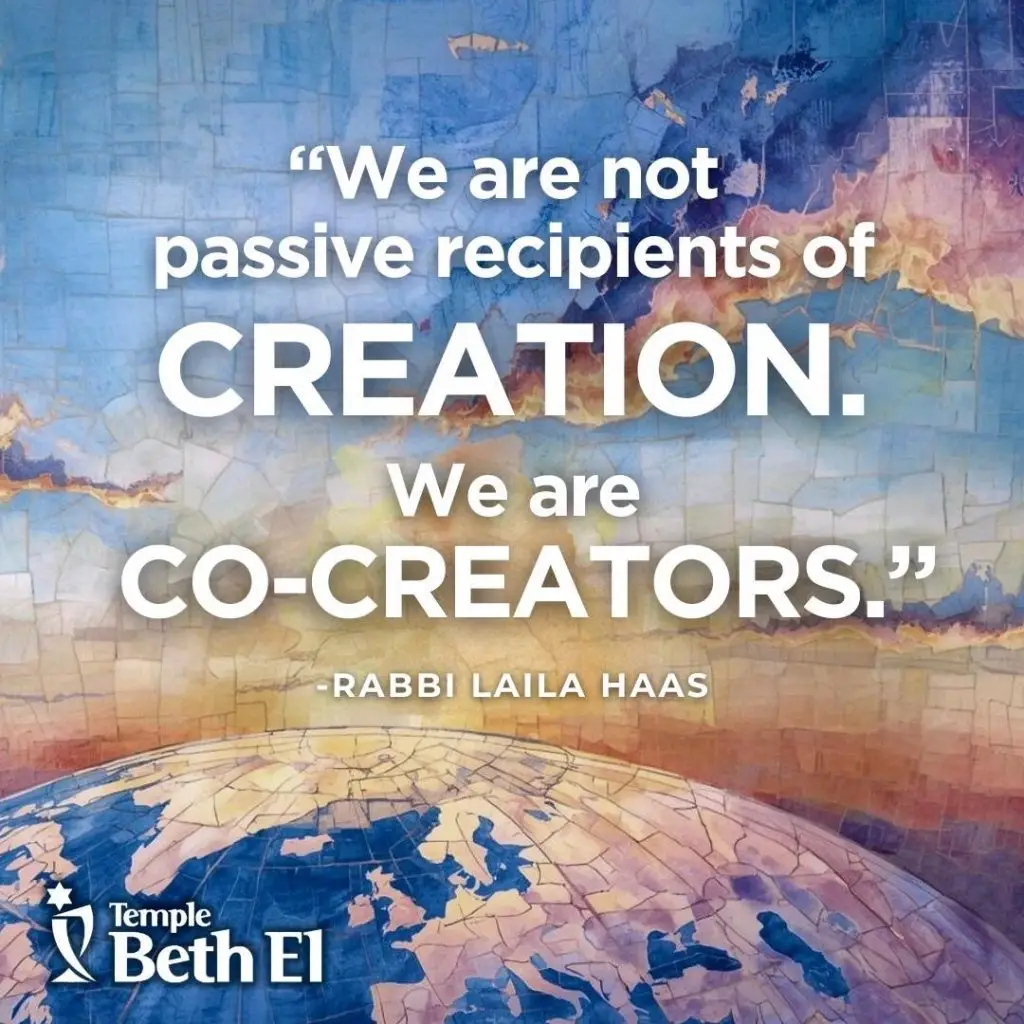
We are not passive recipients of creation. We are co-creators. We build worlds, sometimes out of Legos, sometimes out of ideas and sometimes out of laws. To better understand ourselves, our purpose, our existence in relation to others and the formation of the world we want to create, we must first ask what it means to be who we are. This question is not just for the spiritual realm; it is essential as we navigate the challenges and complexities present in the world today.
As Rabbi Mikva taught last night, history has shown us, if you believe humans are fundamentally evil and need control, you build one kind of justice system. If you believe humans are fundamentally good but shaped by unjust systems, you build another. If you believe the divine image resides equally in all people, you create one set of laws. If you believe some are more “godly” than others, you create entirely different laws. Our ideas about what it means to be human don’t just live in our heads or hearts. They shape everything around us.
Her talk made me think about the fact that we are human beings and yet, we don’t often pause to consider what it means to be a human being.
Priya Parker, in her book The Art of Gathering, teaches that the most meaningful gatherings happen when we ask powerful questions that invite authentic conversation.
As you gather this week with your families and friends, or even on your own, consider asking one another the question: What does it mean to be human?
Here’s the second part of your sacred assignment. I want to learn from you. After you have these conversations, send me the insights you discover. What did your teenager reveal? What did your partner offer? What did you realize about yourself? What did you all determine it means, to be human?
This kind of conversation can change how we see ourselves, how we see each other, and how we build the world we imagine.
Shabbat Shalom.

Rabbi Laila Haas