In this week’s Torah portion, Moses brings the people together to the Mishkan – the holy sanctuary in the midst of the camp. The first thing Moses does is to remind the people to observe Shabbat, and especially to remember the prohibition of kindling a fire.
Fire is a powerful, paradoxical force. It can be harnessed for tremendous good and productivity. It can be unleashed for great harm and destruction.
In the wilderness, a fire could be kindled to cook or bake, to keep warm against the chill, and for the creative work of fashioning metal – gold, silver, copper, and more. We learn in the Talmud that kindling a fire encapsulated all the other productive work to build and sustain the Tabernacle.
But a fire can also be kindled inside. The famous theologian Martin Buber, taught that in order to lead an authentic and passionate Jewish life, one needed to cultivate Hitlahavut. A Lahav is a flame – so Hitlahvut means to be “fired up,” to experience a heart overflowing with passion and excitement.
For Buber, a heart fired-up with fervor was the key to finding God and building a rich spiritual life.
And indeed, this week when the people were asked to provide the talent and materials to build the Mishkan, their hearts were so moved with that ecstatic commitment, that they brought more than could be used.
But fire can also lead to devastation and destruction. Hearts aflame with anger and fear, with indignation and resentment can consume the human soul and literally set the world on fire.
The leaders of Iran have hearts so enflamed with fundamentalist fantasies and radical hatred that for the last fifty years, they leveraged every resource they could muster in their fanatical pursuit to destroy the State of Israel.
Billions upon billions of dollars they could have spent improving the lives of their people were instead directed to build armies and militias across the Middle East, igniting decades of war that killed thousands and destroyed the lives of millions of people.
And when the Iranian people rose up to fight the fires of hate, the regime turned and even fired on their own people.
Antisemitic hatred has ignited a firestorm of violence across the globe. Just this week two synagogues in Europe were attacked with explosives, and two other Toronto synagogues vandalized by gunfire in the middle of the night.
And then yesterday, a man so fired-up with hate filled his truck with explosives, grabbed a gun, and ploughed into the entrance of Temple Israel in West Bloomfield, Michigan – firing shots and setting the synagogue on fire before brave security guards could neutralize the threat and killed him.
The danger of fire is that it too easily kindles other blazes. If we’re not careful, our hearts can also be ignited to hate – kindled from the hatred of those who seek our destruction.
For months, radical Israeli settlers have turned their hate-filled hearts on their Palestinian neighbors, marauding through their villages, setting fires to cars, homes, olive groves, and mosques, with hardly any effort by Israeli police or forces to quell the violence.
A heart fired-up with hate can immolate the human spirit and incinerate the human soul.
But a heart can be fired-up for holiness and goodness, kindled with love and opened to understanding. We can be fired-up for justice and to be pursuers of peace. Our souls can be ignited to fight for dignity and freedom, to dispel our enemies, and to secure the rights of all to live in peace.
As we approach Shabbat, let us work to snuff out the flames of hatred – those that burn in violence and war, and those that smolder in our own wounded hearts.
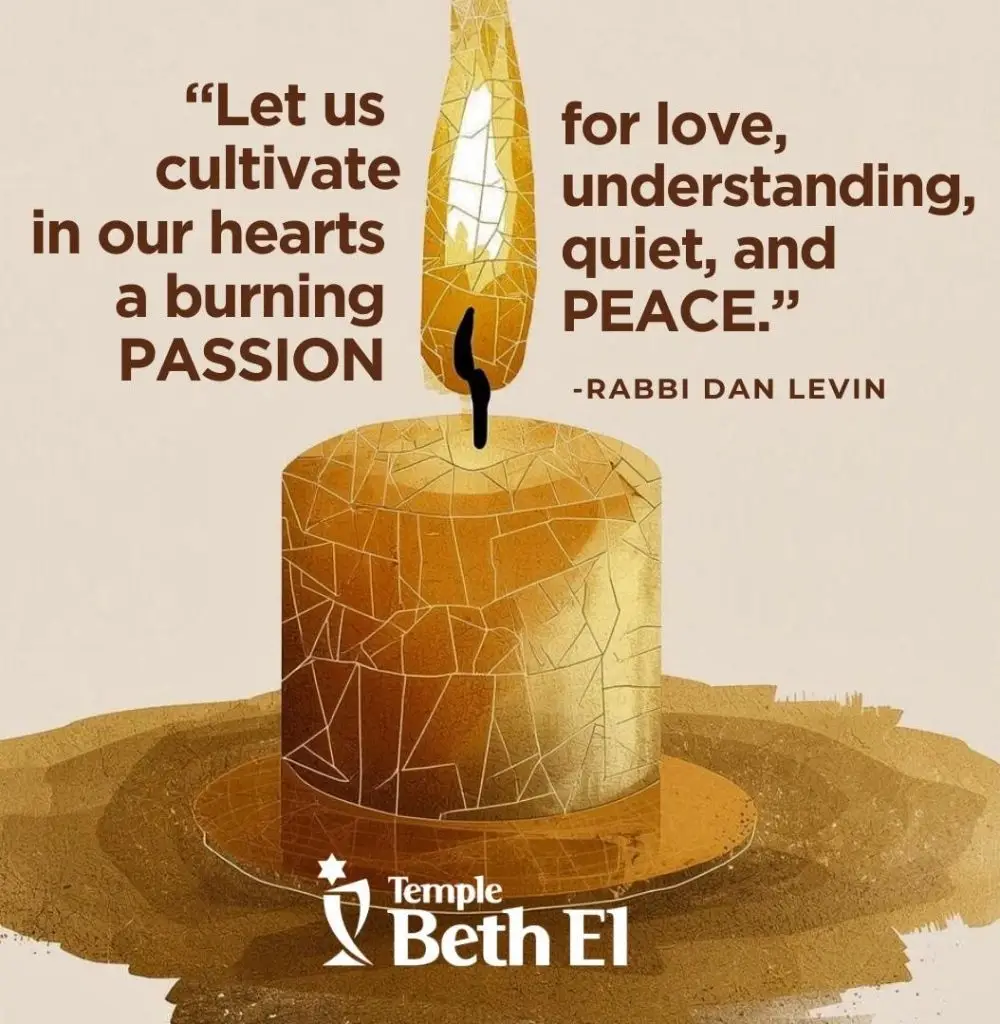
And let us cultivate in our hearts a burning passion for love, understanding, quiet, and peace.
Shabbat Shalom,

Rabbi Dan Levin
Temple Beth El of Boca Raton