My heart is full, and my heart is broken.
This week, as I have for many years, I arrived at URJ Camp Coleman for a few weeks with our people’s next generation of leaders. It’s a privilege to get to spend time at camp, teaching our youth as they expand their sense of self – Jewish and otherwise – in the warm embrace of a supportive Reform Jewish environment and the cooling breezes of the Georgia foothills of the Blue Ridge Mountains.
Going to camp has the same sense of excitement for me at age 42 as it did my first summer at age 9. Despite the work of packing and organizing, the traveling of nearly 700 miles, and the need to adjust away from the creature comforts we’re used to, going to camp is still something that helps my soul feel more peaceful and true to itself than in most other places.
When I get to camp, hear the voices of kids at play, feel the spirit of Birkat Hamazon, our blessing of gratitude that concludes mealtime, and see our kids’ minds and souls actively expanding, my heart fills with joy, with pride, and with a sense of confidence and security that our world is in good hands.
That sense of confidence and security has been much harder to come by this week. As most of us are aware, last Friday a tragedy befell a camp community that is the nightmare every parent fears. As floodwaters raged across the Texas Hill Country, Camp Mystic was inundated in the deluge. Twenty-seven in their community have died, many of them children. The camp’s director, Dick Eastland, gave his life trying to save those of his campers. A few still remain unaccounted for. Our nation’s hearts are broken with those of the families of the 120 confirmed dead.
As my summer at Camp Coleman began, I sat at lunch with our director, and we shared with one another how the pain we are feeling from the tragedy in Texas was affecting us. She takes the wellbeing of our campers so seriously, making their physical and emotional safety a core commitment of her directorship. She has expanded the mental health awareness and resources on camp, and now works with an arborist to ensure the trees around the camp’s cabins and buildings are healthy and strong, mitigating the risk of falling branches in an area known for its summer storms. I shared with her how families who have been preparing to send their kids to camp have told me that they love the fact that the Temple empowers me to spend this time here looking after their kids, knowing that there is an additional set of eyes, pair of hands, and caring heart on site. We had a moment to recognize the pain of the brokenness each of our hearts was feeling, and then just as it always happens at camp, we had to turn on a dime to bring the energy and spirit needed for our next responsibility.
What made that conversation so tragic, as helpful and cathartic as it was, was that we should have been all smiles, hearts full of joy, that the camp session was underway. The dining hall was full, kids were making new lifelong friends at that very moment, and we were feeling the weight of the black cloud of sadness. Both of us knew that we needed to feel that way, even though we knew this moment would have expected us to feel differently.
Emotional and spiritual expectations can be a tricky thing. Sometimes we find ourselves overcome with laughter, remembering an incredibly funny moment in someone’s life, as we are processing the grief of their death. Sometimes the joy of a wedding or a bat mitzvah is dampened because it’s the first family gathering without a matriarch. But when we are aware of the power that emotion and spirit can bring, it empowers us in incredible ways.
In our Torah portion this week, Parashat Balak, we learn of a Canaanite king who is fearful of the strength of the Israelites. Balak had seen the Israelites overrun the Moabites and the Amorites on their path to the Promised Land, so he called upon his sorcerer Balaam to curse the them. In a midrash, the rabbis imagine Balak and Balaam going to a neighboring tribe to ask them what makes the Israelites so powerful. Their answer is that Moses’ words convince God to respond to his pleas. It was not the Israelites’ physical capability, but their spiritual strength that brings them success.
Balaam believes himself just as capable, and opens his mouth to curse Israel. Instead, words of blessing and praise come forth, “How good are your tents, O Jacob, your dwelling places, O Israel!” Once again, the Israelites conquer their foe spiritually before any physical confrontation.
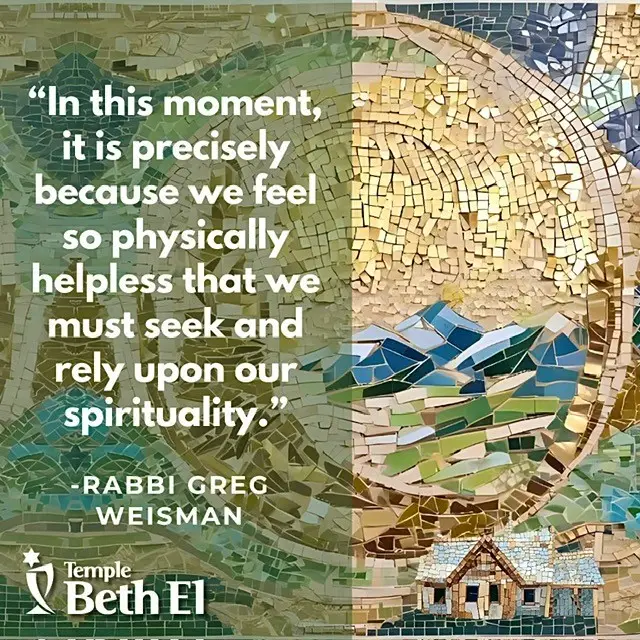
In our Torah portion our spiritual strength leads us to physical. In this moment, it is precisely because we feel so physically helpless that we must seek and rely upon our spirituality. Witnessing the death of so many innocent lives, few of us can be like Coast Guard Petty Officer Scott Ruskan, who saved 165 campers from Camp Mystic, on his first mission as a rescue swimmer. Thank God for his abilities and his accomplishments. But for the rest of us, whether we live in the community or are thousands of miles away, our ability to physically help those devastated feels so limited. Many of us have reached into our pockets to give tzedakah, a holy act in this moment.
But what we can learn in this moment is that the strength in this moment comes from our spiritual selves. It comes from expressing gratitude for the blessings we have been bestowed, like Balaam’s blessing reminded the Israelites. It comes from loving those around us, with our hearts but also with our deeds, in a tacit recognition that we never know when we might lose the chance to do so again. It comes from praying that the memory of the 120 souls lost be a blessing, and that those missing are miraculously found.
It comes when we can use the fullness in our hearts to heal the pain of their brokenness.
Shabbat Shalom from URJ Camp Coleman,
Rabbi Greg Weisman