The most formative experiences of my young life were the 12 summers I spent at summer camp. There I learned a sense of responsibility and independence, how to develop relationships with new people in my life, and how to overcome fears and challenges. There is no doubt that those summers were a significant component to my decision to enter the rabbinate, and I reflect on my time there on an almost daily basis.
As my professional journey developed, I frequently shared my summer camp experience with classmates, colleagues, and others in the Jewish world with whom I have interacted, and they often heard my camp story with a singular sense of surprise: “You went to all ALL BOYS camp?!?” Yep, I spent 12 summers cloistered away in the Northwoods of Wisconsin with 230 other boys and men, and had the time of my life. As much as we all then and now appreciate the incredible women in our lives- our mothers, sisters, wives, children, coworkers, and friends- there was something special about that male-only space that allowed us to unlock parts of who we are. Without having to wonder about how we looked, or how impressive we might be, or who was interested in whom, we were able to cultivate our resilience, talk openly about our fears, and really sit in moments of vulnerability that to this day I believe would have been hindered had we been in a gender-diverse community.
All these years later, some of the guys I went to camp with remain some of my closest friends, trusted confidants, and great resources as we raise our families, grow our careers, and serve the communities in which we live. We grew there to be brothers (even as many of came with our older and younger brothers!); a fraternity that we continue to celebrate and serve. But that growth did not come without challenges, like interpersonal spats, conflicts of pride, jealousies, and moments of competition that boiled over into spite.
Such was the story of two of our biblical ancestral brothers, Jacob and Esau, as well. They quarreled in the womb, took advantage of each others’ vulnerabilities, and as a result lived most of their lives estranged from one another. But in our Parasha this week, Vayishlach, they have a reunification that leads to at least a partial reconciliation.
Jacob had built his household and his family to a significant size, but while they were journeying, he learned that they were approaching Esau’s camp. He sent messengers ahead, learned of the size of the camp, and Jacob genuinely feared that Esau would attack and attempt to destroy him. But those were not Esau’s intentions.
When they finally approached one another, “Esau ran to greet him. He embraced him and, falling on his neck, he kissed him; and they wept.” (Gen 33:4) The text seems so suggest that Esau, to his credit, had long forgiven Jacob for swindling him out of his birthright and blessing, seemingly to Jacob’s surprise. But the writing in the Torah has something curious; the word “he kissed him” is written with six dots above:
וַׄיִּׄשָּׁׄקֵ֑ׄהׄוּׄ
The rabbis are quick to interpret them, and most suggest that they are in some way there to tell us that Esau was withholding his true feelings for Jacob, perhaps holding back to lure him into a sense of security before exacting revenge (as his descendants the Edomites attempted in later generations). But at least one of our great thinkers saw it differently, teaching that those dots are there to teach us that in that moment, love for Esau awakened in Jacob and that in future generations, when the descendants of Esau would genuinely acknowledge Jacob’s greatness, Jacob’s family would reciprocate their feelings of brotherhood.[1]
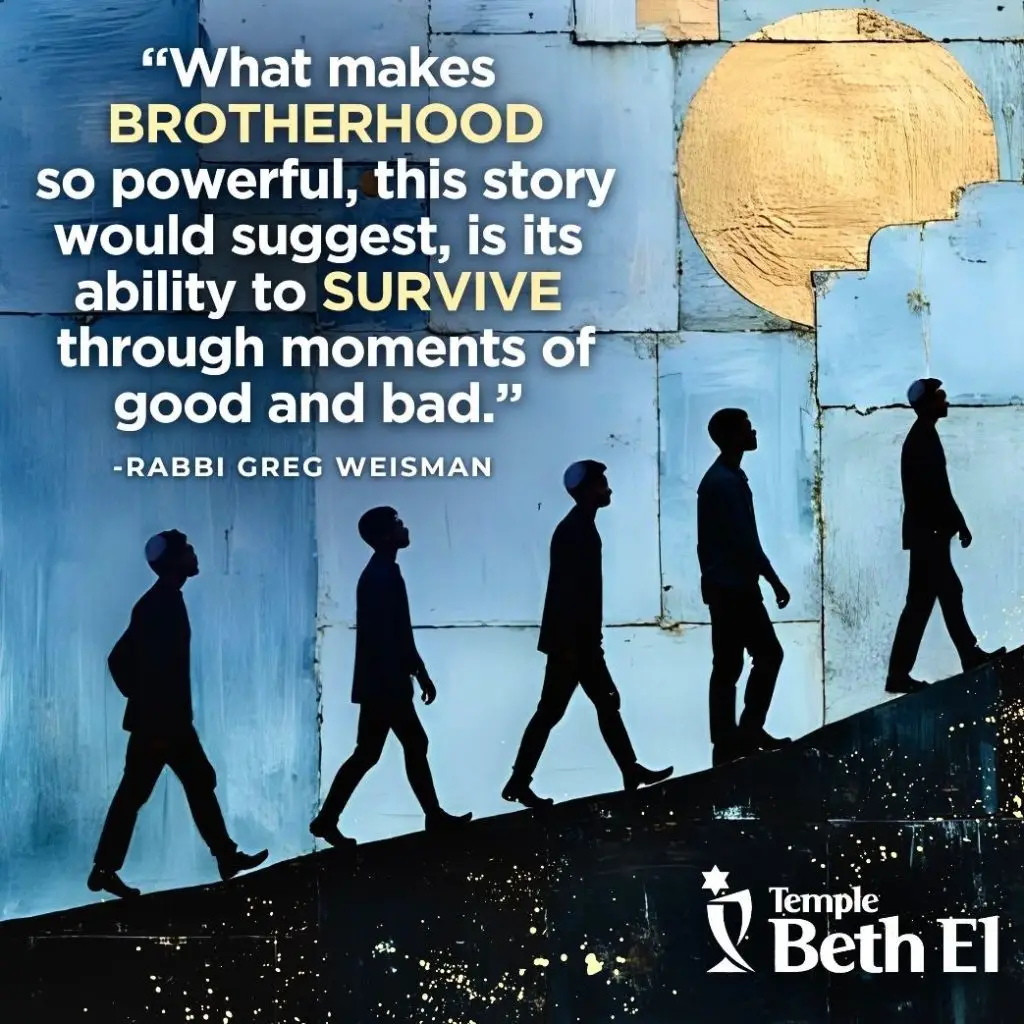
What makes brotherhood so powerful, this story would suggest, it its ability to survive through moments of good and bad. Friendships often end because of a personal conflict, but brotherhood runs so deep that, whatever may have happened in the past, a new chapter can always be opened, with bygones being bygones and love at the front of our heart.
In the summer of 2024 I had the opportunity to return to my summer camp for the first time in fifteen years. At an alumni reunion weekend, I saw some friends that I have stayed in touch with and met some guys for the first time. But the most meaningful moment for me was reconnecting with someone I hadn’t seen in 32 years. He was a counselor my first year at camp, and despite the decades that had past, our brotherhood allowed us to jump right back into conversation with ease and comfort.
Tonight at our 6:00 pm Shabbat service, we will celebrate our congregation’s Brotherhood; a group of engaged congregational leaders who have filled our community with spirit and energy. We will hear their stories of how the relationships they have built and experiences they have had have enhanced their lives. Like most congregational groups, there are moments of tension and moments of great success in our Brotherhood’s history. But rather than let those tense moments inhibit us, we have learned to turn them into generative opportunities for growth. Just as the tension between Esau and Jacob resolved and the kiss from Esau brought, they have had incredible moments of greatness as they have shared their brotherhood with one another.
My prayers this Shabbat are that we can be inspired by their work in our community, and by the notion that despite the ups and downs that any relationship might experience, deep ties to those closest to allow can enable us to better appreciate the blessings in our lives.
[
[1] Haamek Davar on Genesis 33:4.
reg Weisman