Click here to listen to an audio recording of this Shabbat Message by Rabbi Greg Weisman.
Monday evening, in a room filled with Evangelical Christian pastors and rabbis, we recited the words “Hinei Ma Tov U’Ma Naim, Shevet Achim Gam Yachad – How good and pleasant it is when God’s people live together in unity!”
It was a new experience for me.
The Jewish and Evangelical communities do not have a long history of collaborative partnership. Our temple has strong relationships with our local Catholic, Episcopal, Latter-Day Saints, Lutheran, Methodist, and Muslim neighbors, but our relationship with local Evangelical churches is distant at best. So, when our local Jewish Federation asked me to travel to Washington as part of an interfaith advocacy effort for Israel and to confront antisemitism, led by evangelical churches, I went, with great curiosity.
Over the past several decades, there has been a significant rise in Zionism and support for Israel within large parts of the Evangelical community. CUFI, Christians United for Israel, was founded in 2006, and touts itself and its 10 million members as the largest pro-Israel organization in the country. While their advocacy work has had an incredible impact on our nation’s continued support for Israel, much of it happens separately from the advocacy that the Jewish community leads. Many in their network are motivated by their religious views of the world, focused on the Holy Land, but less concerned with the plight of the Jewish people. Disappointingly, a significant segment of the Evangelical community, even those who envision a safe and secure Israel, remains ambivalent toward, or sometimes contributes to, the rise of antisemitism here in the US.
But not the community of Evangelicals I met this week.
Sitting around a dinner of 550 people, only about 100 of them Jewish, we sang Hatikvah and Am Yisrael Chai. We heard from pastors and scholars who taught that their Christian theology calls them to love and protect the Jewish people, in Israel and around the world. The next day, we went to the U.S. Capitol together, meeting with our senators and representatives, and reminded them of the importance of the unshakable relationship between the U.S. and the State of Israel, as well as the need to continue to combat the rise of antisemitism in our communities around the country.
Part of our agenda was the need for continued federal funding for security grants for houses of worship. I shared how our congregation’s security costs have grown steadily over the past decade, and how state and federal funds have helped offset some of that burden. Every Jewish institution, and every person who enters one, knows this new reality. I was struck, however, when the pastors I was with shared that they, too, have had to invest in their own security. Why? Because their support for Israel and the Jewish people has made them targets as well.
When we celebrated the goodness of all of God’s people being unified at the start of our visit, I didn’t imagine that unity would be in a shared state of vulnerability. I would have hoped, inspired by the words of this week’s Torah portion, that it would come from a sense of peace instead. In Parashat Behar-Bechukotai we read: “I will grant peace in the land, and you shall lie down untroubled by anyone,” a blessing God offered our ancestors as they prepared to settle in the Land of Israel. Two centuries ago, Rabbi Nachman of Breslov wrote that this peace comes from “sparks [ascending] earthiness to make peace, this being the primary rectification of the creation…one must speak only holy words and no others, in order to elevate the aforementioned sparks and rectify all the worlds.”
When we speak words of peace, when we join together in the pursuit of building a world that is improved and repaired, that, Reb Nachman teaches, is an act of holiness and engenders the blessings of the Holy One.
Going around conference tables in congressional offices, we shared words of fear, resilience, and mutual respect, hoping that through them we might perform the act of rectification Reb Nachman described.
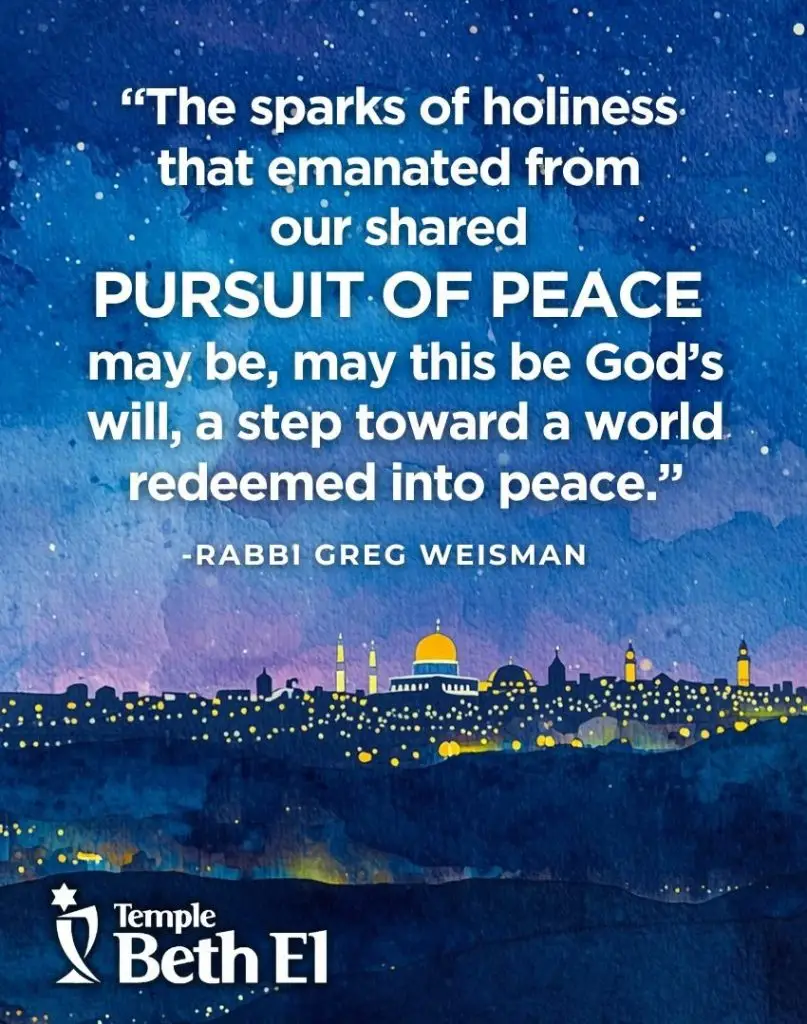
There is no question that the world feels unsettled right now. It is unsettling that we needed to go to Washington to advocate for our physical safety. It is unsettling that people outside the Jewish community feel themselves at risk simply for standing with us. But the sparks of holiness that emanated from our shared pursuit of peace, may this be God’s will, a step toward a world redeemed into peace.
Shabbat Shalom,

Rabbi Greg Weisman