It really is a miracle that we are still here.
If you ask scholars of ancient civilizations, they would tell you that there is no good reason that the Jewish people are still around. Dozens and dozens of groups have come and gone since God called upon Abraham to leave the land and community he was born into to start a new nation. Some of those nations are named in the Torah, like the Canaanites and the Perizzites. Some have attacked and tried to subjugate us, like the Assyrians and the Babylonians. The Roman Empire and the British Empire have risen to near global domination, only to have their power and influence recede to the status of “regular” nation. All along the way, countless minority groups have come and gone, many at best footnotes in the history of civilization.
But for thousands of years, the Jewish people have found a way to survive whatever challenge presented itself, and here we are some 4000 years after Abraham and Sarah started it all.
So, what’s the secret? How did this miracle come to be?
An obvious answer is in Abraham’s story, when God promised Abraham to look after his descendants, to make them as numbers as the stars of the sky, and to bless those who would bless them. How are we still here? Because God made it be so.
That is a spiritually satisfying answer, but inquiring minds would like to know: “How?” It was more than God protecting us in moments of peril, preventing us from extinction. There must have been things God did for us, or things that God gave us, that enabled us to navigate and weather thousands of years of history and challenges, that empowered us to survive and even thrive.
Of course, there are, and one important one is sitting in this week’s Torah portion, Vaetchanan. The Parasha has perhaps our tradition’s most famous words, the words of the Shema and V’ahavta, along with the second iteration of the Ten Commandments. If you want one Torah portion that can be held up as the clearest example of what it means to live a Jewish life, this one may be it.
The verses in our portion start with the Shema and go into the V’ahavta set for us the responsibility to consider and engage with our tradition and its teachings on a daily basis: when we go to bed, when we get up, when we are walking about, when we leave or enter our houses and see our mezuzot.
Everywhere we go we remind ourselves of the responsibilities as Jews that we have towards God and towards one another. But embedded within the litany of times in our daily lives when we are to consider our responsibilities is something that extends and expands them through the generations: the words ViShinantam L’vanecha.
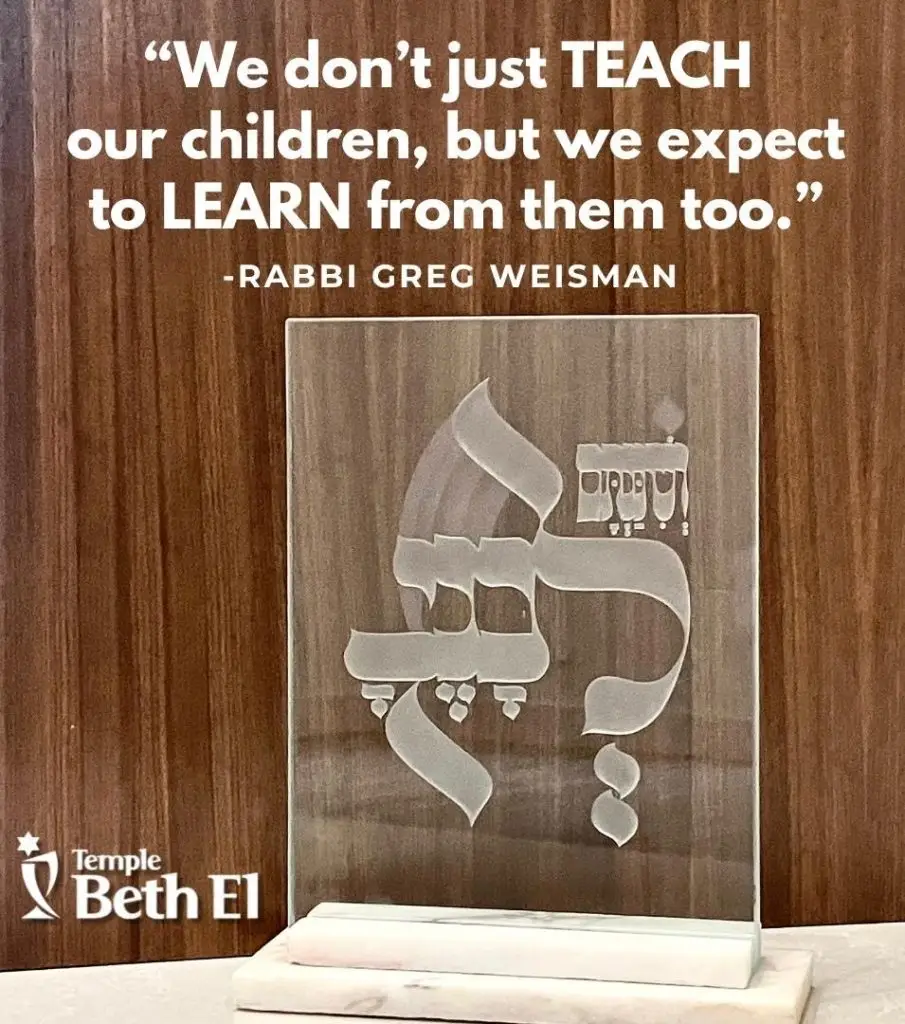
This phrase, ViShinantam L’vanecha, is often translated as “speak of them,” or “teach them” to your children. We are given the clear instruction that one of our responsibilities, one of our mitzvot, is to pass on our tradition to the next generation, to ensure that it survives even after we are gone. In the Talmud, the rabbis talk about teaching to our children, and to ensure that they teach it to their children, teaching us that we have not really fulfilled this mitzvah until we know that we have added links to the chain that will survive us. Perhaps then it is our commitment to this responsibility, is part of the miracle of our survival. Throughout our generations, we have known that our job was not only to receive the tradition, but to make it our responsibility to see it through to the next one. Whatever challenges we might face, our success as individual Jews is tied into our success as the collective Jewish people.
Whenever I look at these words, my mind cannot help but think of the late 60’s song “Teach Your Children,” written by Graham Nash and made famous by his group Crosby, Stills, Nash, & Young. Nash had a difficult relationship with his father, and wrote the song as healing expression of the responsibilities between parents and children. Parents, we must teach our kids to be kind, to care for others, to live with a sense of value and purpose. But as the song reaches its conclusion it flips the script generationally, telling us children that we have a responsibility to teach our parents what, under their guidance and tutelage, we have learned in our own generation. In each generation we glean the wisdom of those before, and then add to it what we develop on our own, the song seems to say.
That is the miracle of V’shinantam L’vanecha, and the key to our survival: we don’t just teach our children, but we expect to learn from them too. We give them everything that has been given to us, all the inscription, all the experience, all the wisdom that has been gleaned. But we expect them to make it theirs, to grow with it, to grow from it, and to help that wisdom to grow. We want our kids to be even more insightful, even more understanding than we are. We want them to stand on our shoulders so they can see farther. When we do that, we as a people get stronger and stronger through the generations. When we do that, we partner with the Holy One in ensuring our survival, whatever may come.
Rabbi Greg Weisman