It’s finally here! Today is the day that Wicked: For Good premieres in the theaters, something that many in our lives have been waiting for for a year. This recasting of the characters of The Wizard of Oz explores the path of the Wicked Witch of the West from outsider to favored student; from disillusionment with the corruption of those in power to revenge on all those who turned on her. The novel turned musical, turned film is an exploration of the complexity of each of the players, illustrating a basic truth, which is that no one has just one side to their character.
Ironic, then, that we read Parashat Toldot this week, which teaches us a similar truth. It is the story of Jacob and Esau, the third generation of our biblical patriarchy, one that was mired in intense sibling rivalry starting in utero. Twins, they fought so tumultuously in Rebecca’s womb that she wondered to God why she continued to live.
In their young lives, Jacob and Esau’s relationship was not much better. They built competing alliances with their parents, Esau with Isaac and Jacob with Rebecca. One day, Esau, famished from a day of hunting, sold his birthright to Jacob for a measly bowl of lentil stew, an opportunistic Jacob taking advantage of his brother’s temporary lapse of judgement. Years later, as Isaac was nearing his end, Jacob and Rebecca conspired to dupe Isaac into giving the blessing of the first-born son to Jacob. They dressed Jacob in animal skins and convinced a blind and enfeebled Isaac that he was Esau. Esau, now twice deceived by his brother, lashed out, and fearing his brother’s fratricidal rage, Jacob ran away back to Rebecca’s father Laban. The brothers lived the rest of their lives separate from one other.
Each year when I read this Parasha, my heart breaks for Esau. Yes, he acted rashly when coming back famished, but rather than greet him with empathy and concern, Jacob took advantage of Esau’s hypoglycemic impulsiveness. Like the Witch of the West Elphaba’s character in Wicked, Esau was blessed with a strong sense of care and concern, and deep love for those who showed kindness and respect. Esau was an incredibly loving son; living out the values of the society of his time, he would go on the hunt to provide for his family. As Isaac’s years were coming to their end, Esau set out to do the thing he knew would bring his father joy in what little life he had left, and once again went on the hunt to bring him a favorite meal.
The rabbis of the midrashim teach that Esau was one of the most dutiful sons our tradition has seen. Rabban Shimon ben Gamliel shared that like so many others, he would wear his schleppy clothes around the house, including in the presence of his parents, and save his finer clothes for going out. But Esau, the rabbi taught, when he would attend his father, he would attend him only with royal garments. He said: “It is not in keeping with Father’s honor to attend him in anything other than royal garments.” For that reason, Rabban Shimon ben Gamliel said, “I have attended my father all of my days, and I did not attend him with one one-hundredth of what Esau attended his father.”[1]
Despite this, much of the tradition refers to Esau as “the Wicked Esau.” It started when Esau eschewed his birthright, but really took hold as Esau’s descendants, the Edomites, took advantage of the Israelites’ vulnerability as they were journeying from Egypt to Israel. The rabbis blame Esau for their actions, and thus teach us that he was “wicked.” But later teachers[2] see Esau’s devotion to the mitzvah of honoring one’s parents as a strong counterbalance to his supposed wickedness, saying that God does not distinguish between the righteous and the wicked in this regard.
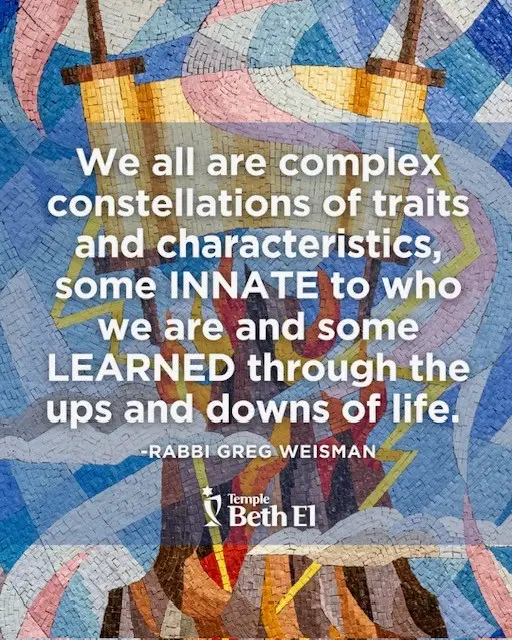
But past the rabbis’ acknowledgment of Esau’s devotion to his father, their observations teach us a larger important message too. No one can be reduced to a single characteristic. The “wicked” Esau was also a loving son. Our “beloved” Jacob was at time conniving (and a father who favored one son over all the others). Abraham twice tried to pass his wife off as his sister. Elphaba overcame ostracization to build meaningful relationships, only to see her supposed friends turn on her as she pointed out the corruption they trafficked in. We all are complex constellations of traits and characteristics, some innate to who we are and some learned through the ups and downs of life. “Each of us,” the author Bryan Stevenson wrote, “is more than the worst thing we’ve ever done.”
As observers of everyone else in the world, we have choices to make. When do we hold people’s mistakes against them? When do we meet them with grace? When can we forgive, but not forget? When can we be a part of their growth process?
Although they later reconcile, Jacob and Esau are essentially out of each other’s lives until the end, twin-brother-only-children. It was a shame that their inclinations towards judgment and wickedness prevented them from seeing the good in each other, but perhaps their story can teach us that lesson, and we can make it a part of our lives, for good.
[1] Genesis Rabbah 65:16
[2] Kad HaKemach,, a 14th Century Mussar collection by Spanish rabbi Bachya ben Asher
Rabbi Greg Weisman