There is a famous story that involves a mountaintop fortress, two thousand years, and a date seed. Two thousand years ago, King Herod built Masada, a fortress built into a mountain overlooking the Dead Sea. A generation later, a small group of Jewish zealots fled the Roman Empire, taking refuge in that mountaintop fortress, refusing to abandon their way of life. When faced with five Roman legions laying siege, they made the decision to take their own lives rather than be forcibly converted to paganism or give the Romans the satisfaction of slaughtering them all. The fortress was left to ruin.
In the 1960s, archeologists unearthed the ruins, finding a synagogue, a bathhouse, a cistern, and food storehouses. Amazingly, in the storehouses they found seeds, preserved by the dry air of the Judean Desert. The seeds were collected and protected with modern preservation until 2008, when scientists planted a seed. Miraculously, despite its age (verified by carbon dating), the seed germinated and grew. “The righteous will flower like the date palm,” the Psalms say. This three-thousand-year-old text aptly describes a miracle two thousand years in the making…and all of this is a fitting metaphor for that palm tree’s home, Israel.
I heard this story again last week, standing on the top of Masada with a group of our congregation’s teenagers. Over a week, we went to Tel Aviv and Tzfat, Zichron Ya’akov and Jerusalem, and the Gaza Envelope. We saw some of Israel’s most incredible achievements, and bore witness to the memories of her moments of searing pain. And we stood on top of Masada, braving cold wind and rain, to hear the story of that date seed. We challenged the teens to ask themselves, “what would I do?” if they were one of the zealots on that mountaintop? Could they find the courage to stand up to the Romans, and where would it come from? As they have already learned, our people have had to summon their courage to face down a foe time and time again, and we who inherit their stories keep their memory alive.
Elsewhere in the Psalms we read, “Those who sow in tears will reap in joy.” It’s almost as if the psalmist could see into the future, knowing that our people would face some of humanity’s most difficult challenges and we would emerge, carried by the hope that a better day would come. The modern State of Israel is the manifestation of that hope, our eternal hope and belief that while we may endure periods of hardship, the page will turn to an era of thriving and plenty.
Throughout our week in Israel, my goal was that our teens would draw inspiration from the stories of our people to guide them on their own journeys. When we walked through the solemn halls of Yad Vashem, Israel’s national monument and museum to the memory of the Holocaust, our path literally lowered by a few feet as the journey took us into the depts of the extermination machine. But as we learned about the Righteous Among the Gentiles, the liberation of the camps, and the continued project of Zionism the floor sloped gently up again, until we walked out to a vista of modern Jerusalem in all of her golden splendor. We emerged, ready to recover, thirsting to thrive.
The day before, we visited Kibbutz Nahal Oz, the closest Israeli community to the Gaza border. Hearing from a member of the kibbutz who just three weeks ago moved back into his house on the kibbutz, our hearts broke as he recalled the horror of October 7, and soared as he told of the bravery of those few IDF soldiers and local security forces who neutralized the terrorists, saving him and his family.
Near Bet Guvrin, with picks and shovels in our hands, we contributed to the ongoing archeological exploration of an olive press from the time of the Maccabees yet another story of our people’s resolve to overcome whatever was before them, so that the beauty of our people and our nation could survive another generation.
In Tel Aviv, at Hostage Square (and really throughout the country), we bore witness to the continuing vigil for Ran Gvili, z”l, the last hostage who has not yet returned home. As a nation we are praying that the wound of his death on October 7 can start to heal by receiving his remains and laying them to rest.
Each of those stories, and the many others we heard, told of us journeys from peace, to pain, to healing, and back to strength. Many of them took generations to complete that journey, with youth picking up where their elders left off. That is why we took our teenagers; our leaders of the generation to come, and why our congregation has invested in this experience for them. We want them, we need them, to hear the stories of triumph after tragedy, and to see the outcome with their own eyes.
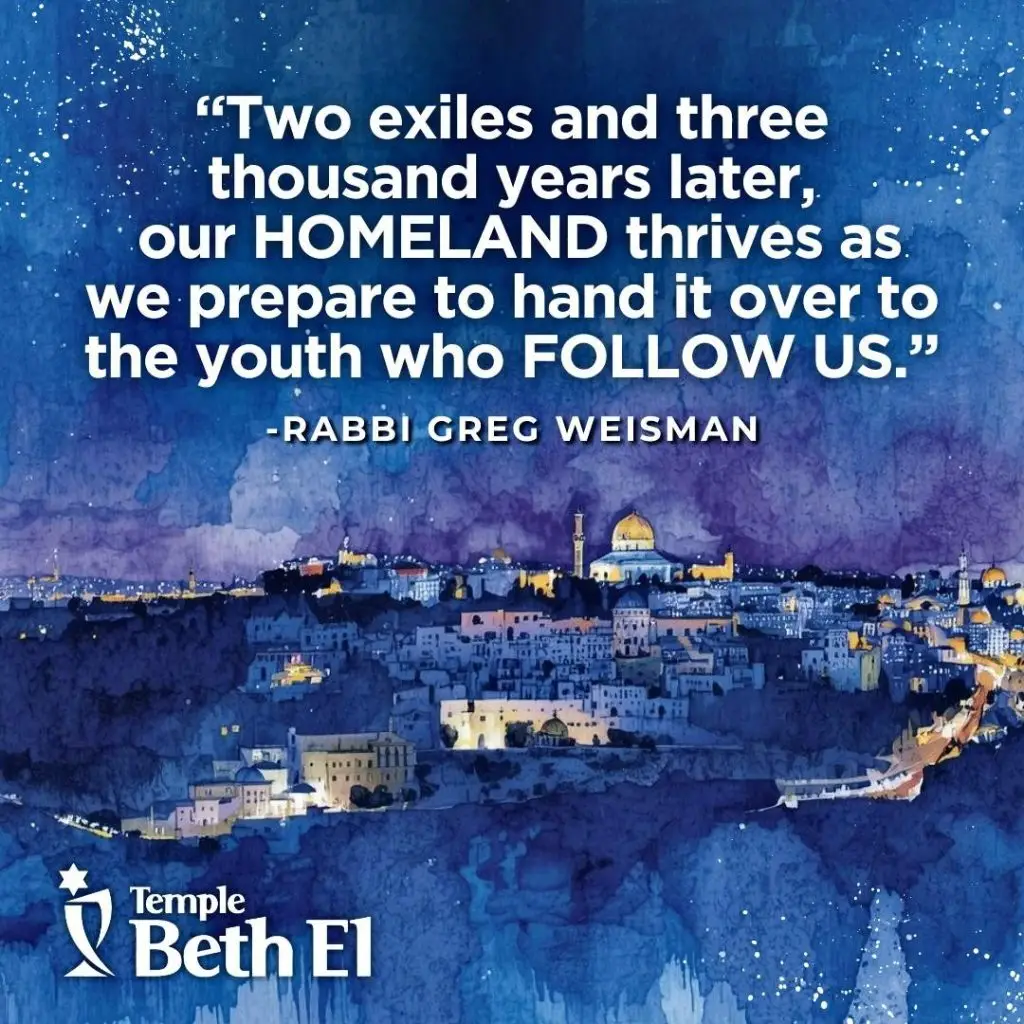
This week, as we conclude the Book of Genesis, we read of the success of the generations of Jacob and Joseph that gave way to the enslavement of our people. It took hundreds of years, but they were redeemed and make their way back to our homeland. Two exiles and three thousand years later, our homeland thrives as we prepare to hand it over to the youth who follow us. Watching them walk in our ancestors footsteps, I watched our teens bring curiosity, passion, pride, and warmth to our journey. As leaders of their generation, I’m inspired by what they might accomplish, believing that the joy we reap today will pale in comparison to the joy that they will bring tomorrow.
Am Yisrael Chai, and Shabbat Shalom,
Rabbi Greg Weisman